


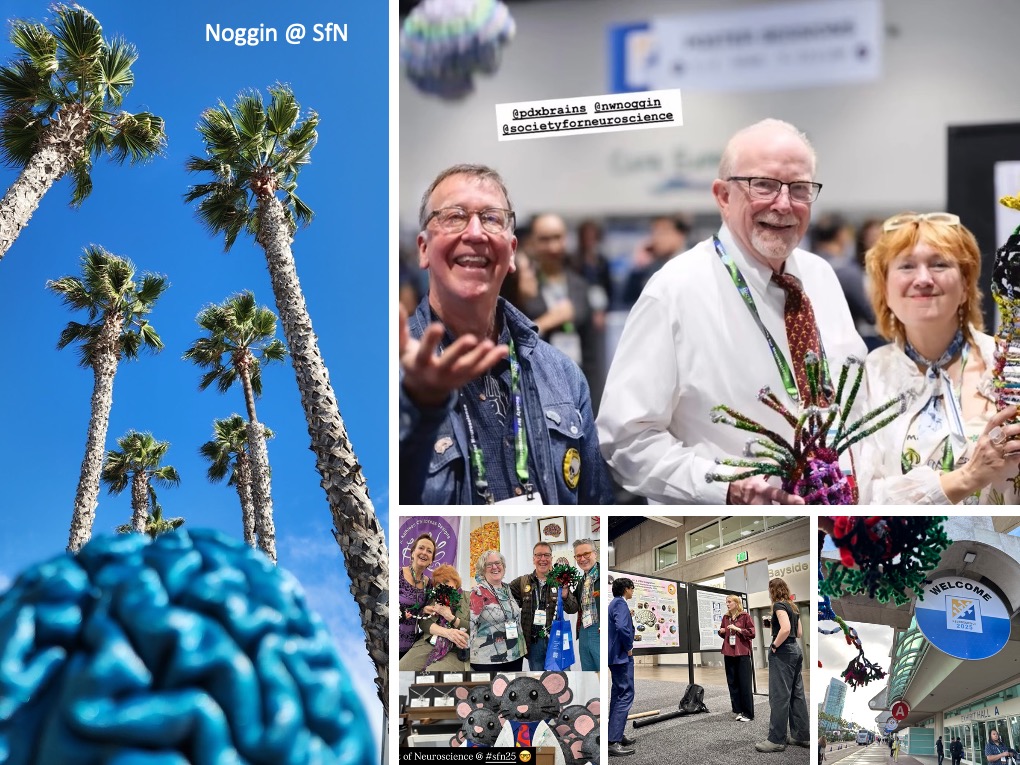
Northwest Noggin has joined the annual Society for Neuroscience conference with our undergraduate and graduate volunteers since 2013 in New Orleans – a city they no longer visit because (we’ve been told) so many failed to show up for morning sessions!
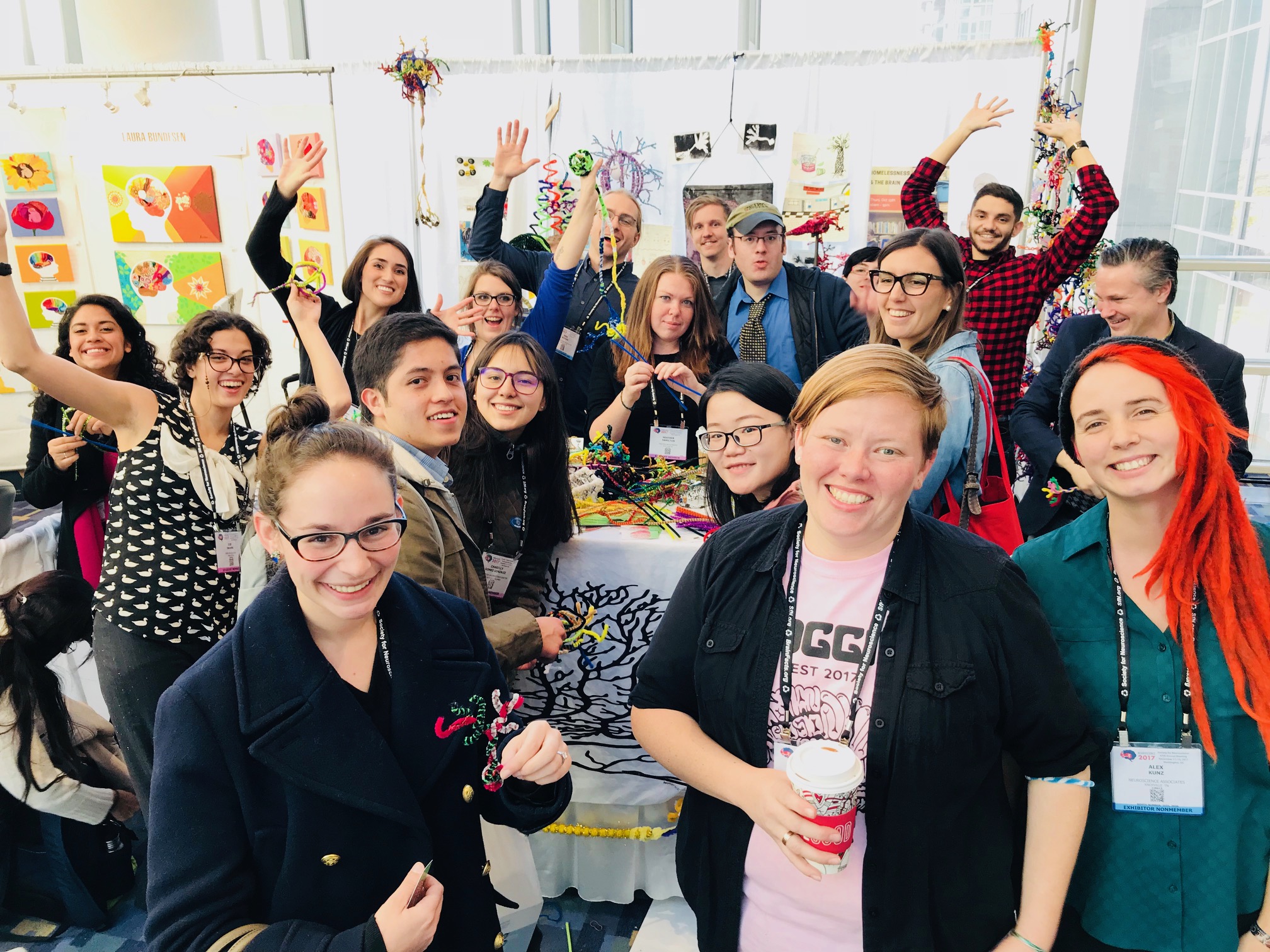
But we’ve always been there!
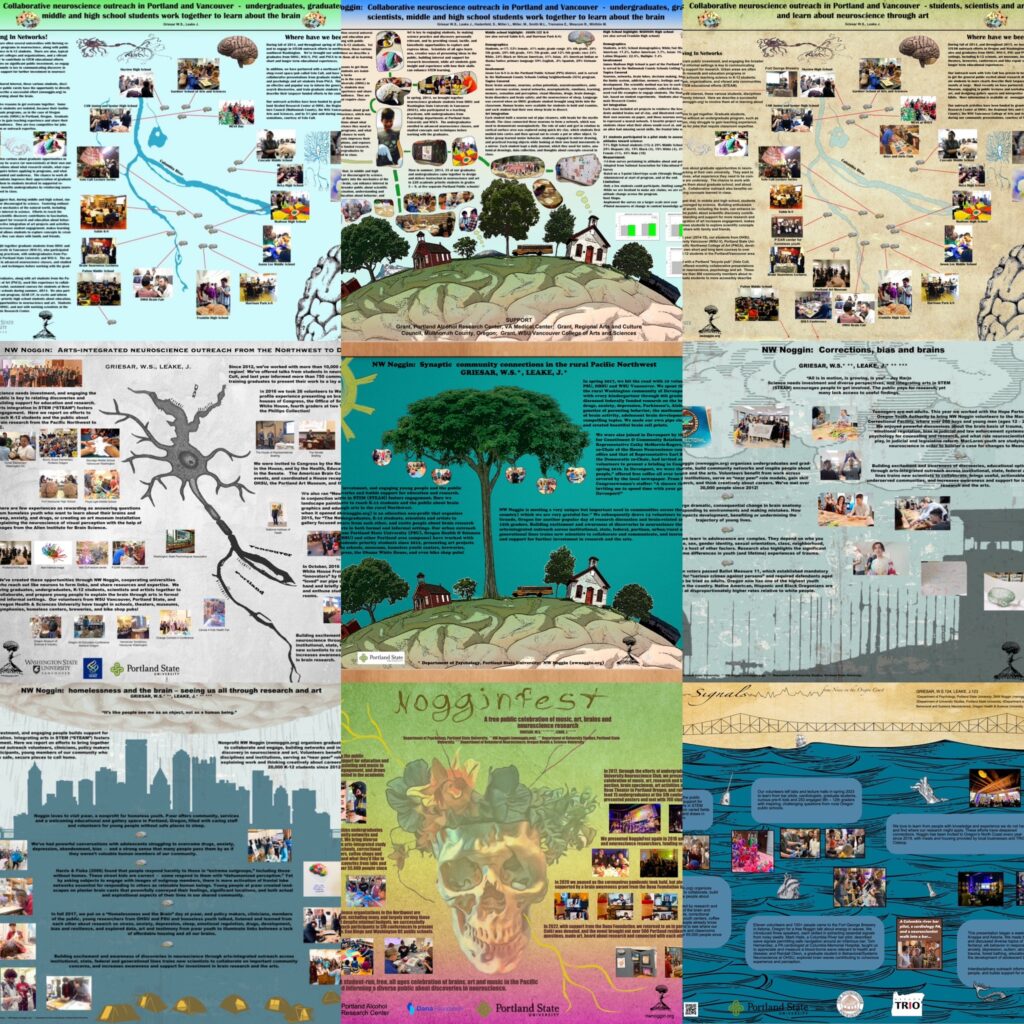
We’ve not only presented Jeff Leake’s colorful posters on our outreach activities, but we’ve also consistently visited public K-12 classrooms in Washington DC, Chicago and most recently San Diego!
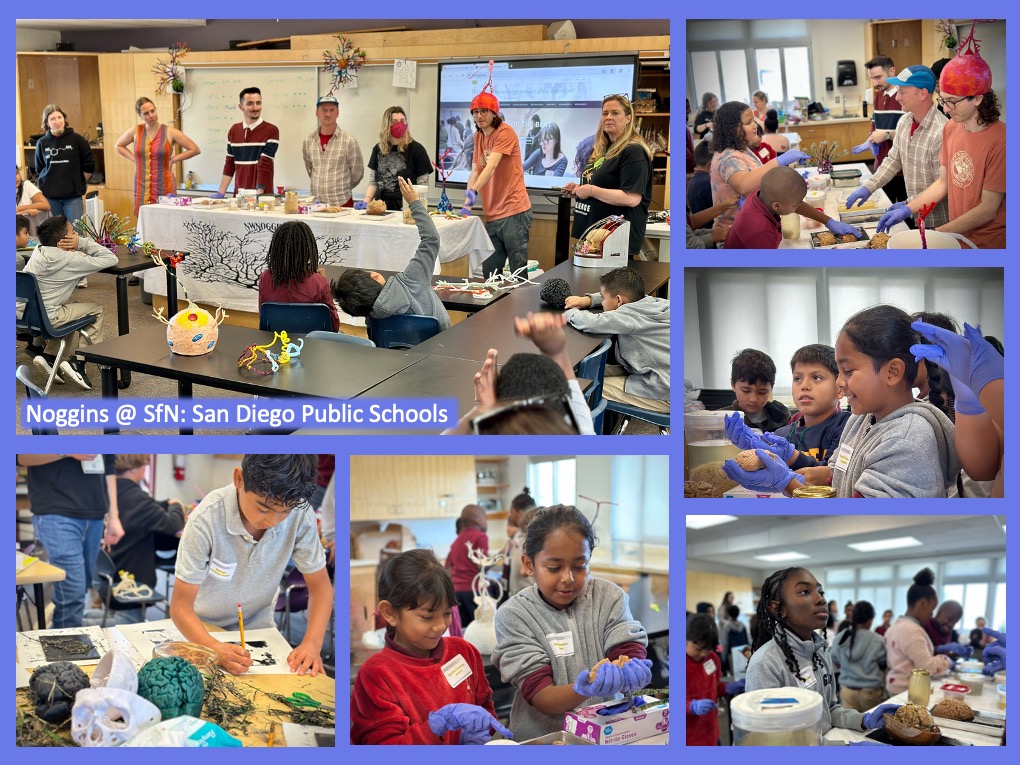
LEARN MORE: Noggin @ Schools & SfN in San Diego!
LEARN MORE: Noggin @ Society for Neuroscience
Our abstracts and posters communicate our entirely free, volunteer collaborations with urban and rural public schools, houseless youth organizations, public correctional facilities, Indigenous communities and fellow nonprofit groups. We are less interested in admission and tuition charging institutions, particularly those that limit public access or questions, or censor freedom of expression.
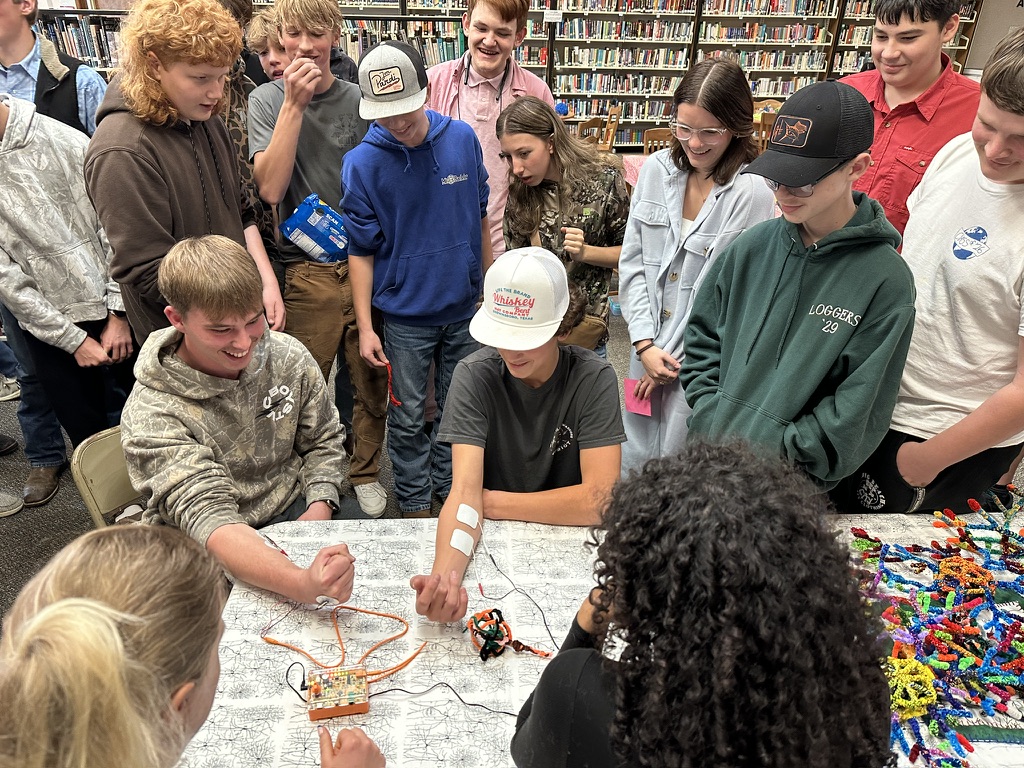
LEARN MORE: Noggin Bloggin
In 2018 we presented the keynote address on Brain Awareness 😎
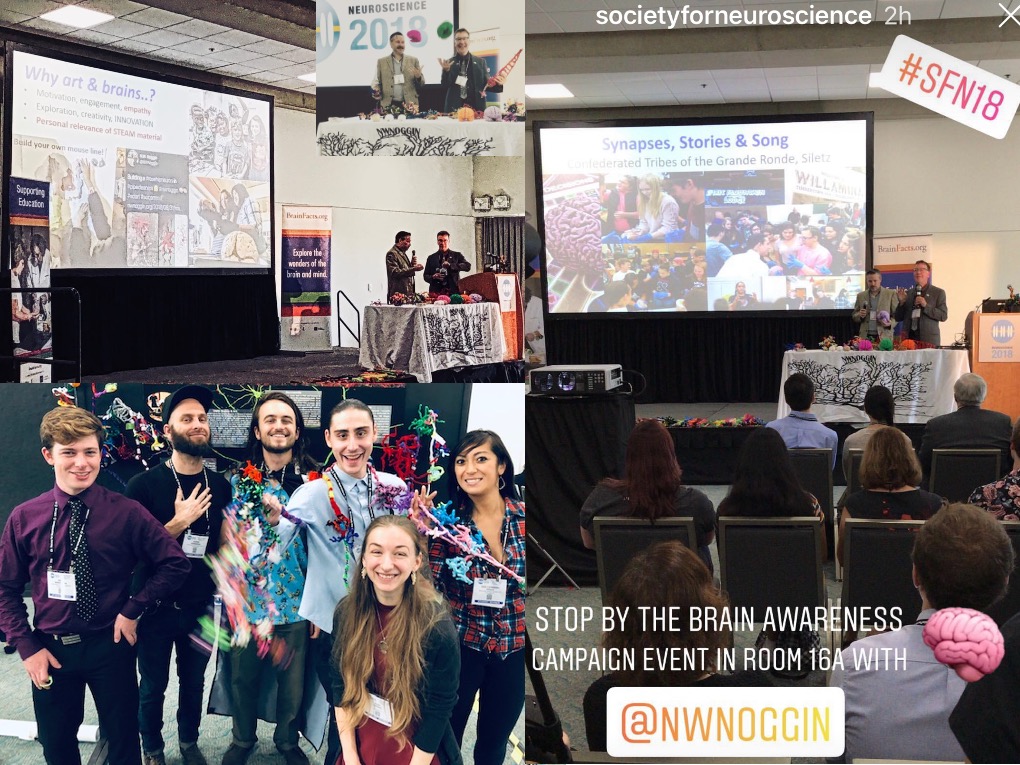
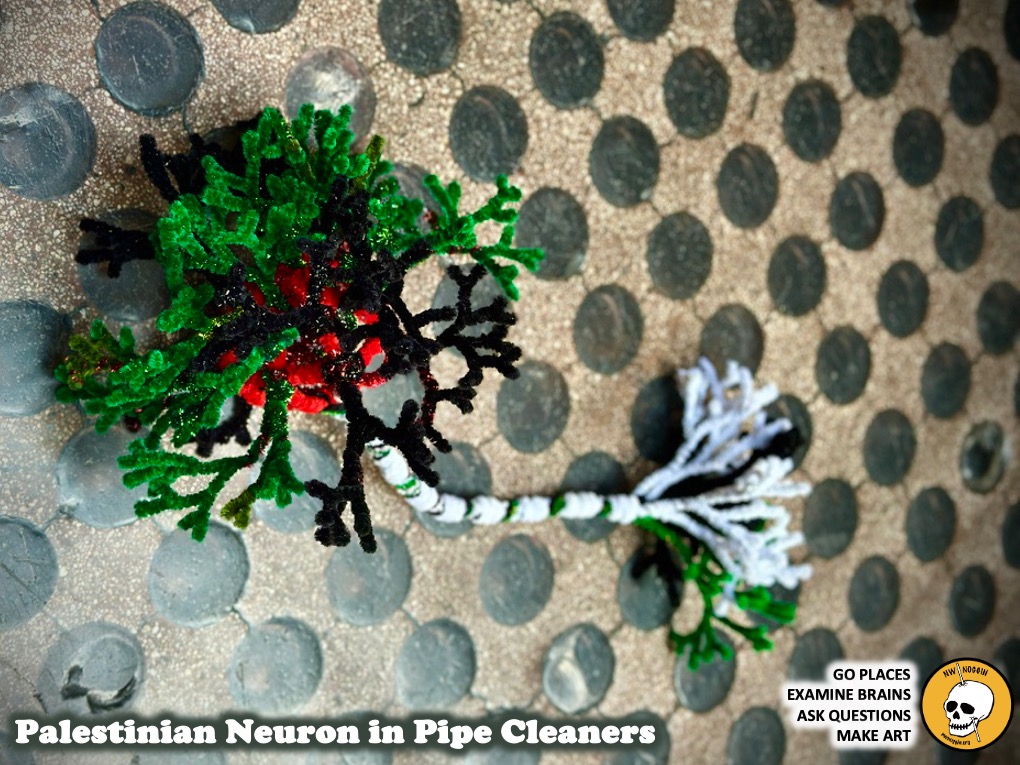
And (of course) we’ve crafted MANY pipe cleaner brain cells with SfN attendees!
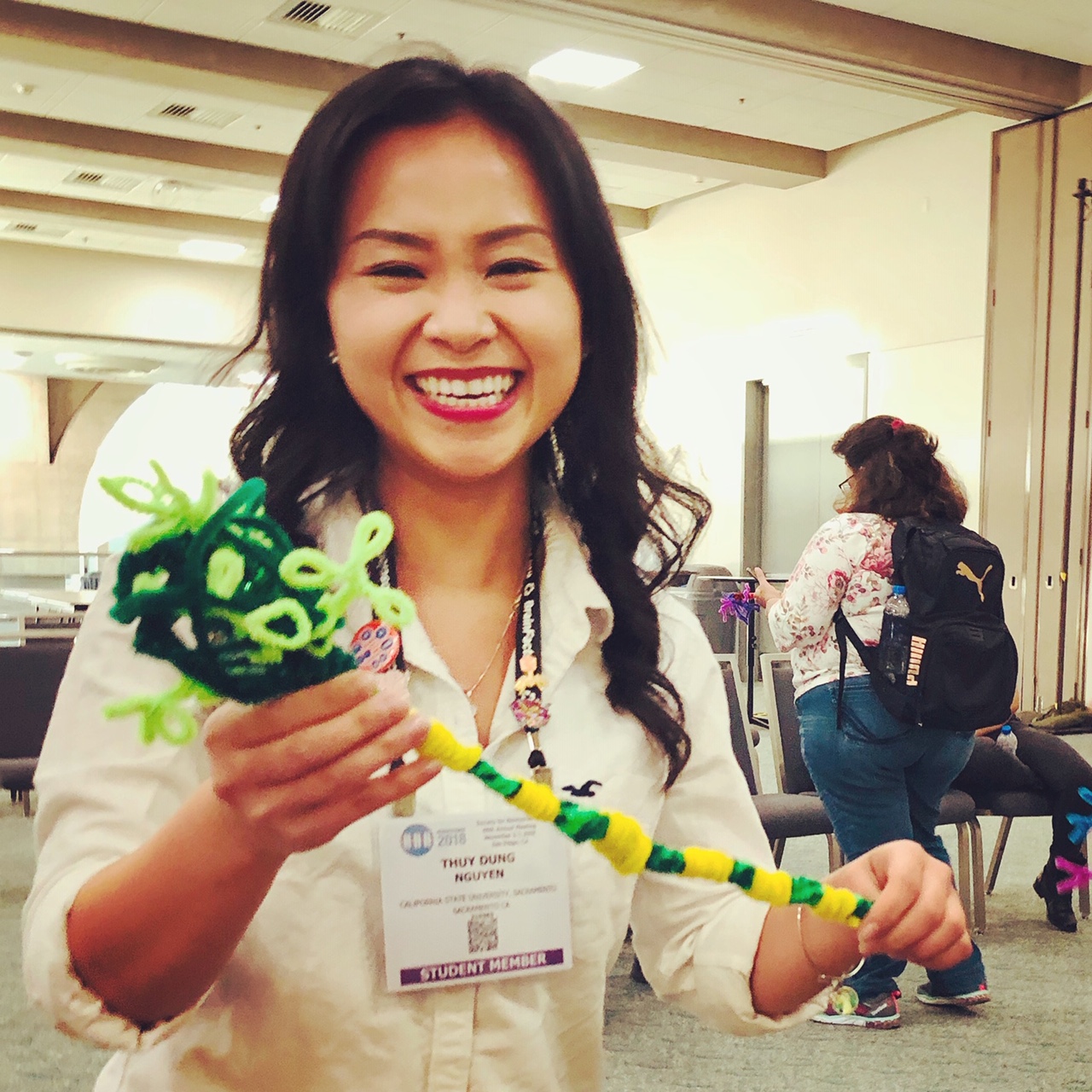
LEARN MORE: Synapsing in San Diego @ SfN!
LEARN MORE: Until the Story Takes Shape
How do we reach SfN?
We love SfN, and look forward to returning to their annual conference. It’s not an easy lift, as our own universities offer minimal funds for travel and participation. SfN has helped by waiving registration fees for our outreach volunteers. NW Noggin also values donations and seeks support from grants.
DONATE: Northwest Noggin
Undergraduates in Portland State’s Interdisciplinary Neuroscience Association work especially hard to raise funds through NOGGINFEST, the largest free, all ages, public celebration of music, art and neuroscience research in the Pacific Northwest! There is also limited support for travel from the Student Activities and Leadership Program (SALP) at Portland State University.
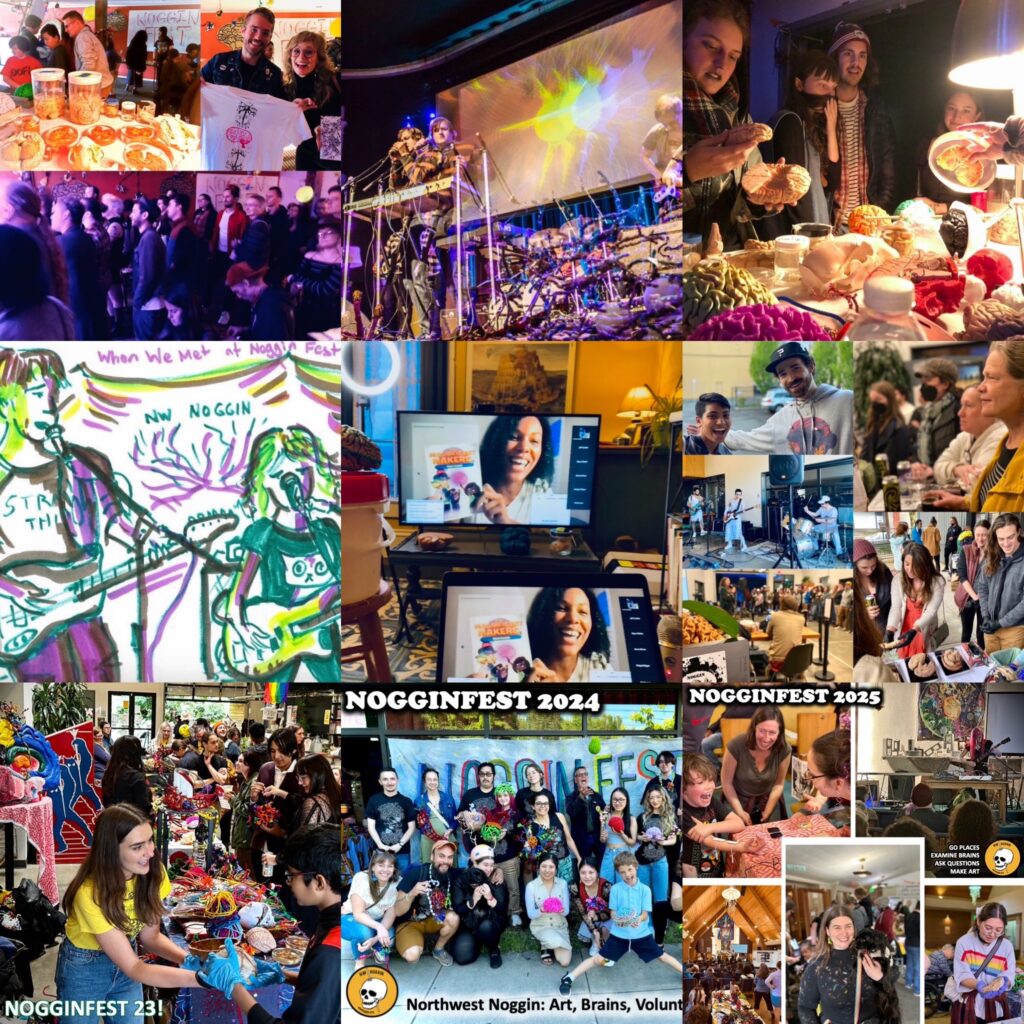
JOIN US SATURDAY, MARCH 6 AT NOGGINFEST 2027
LEARN MORE: NogginFest!
Noggins in Gaza
We were stoked to return this fall to beautiful San Diego, and share another extraordinary volunteer experience with over 20,000 attendees. We’d collaborated since winter with Abdulrahman Abou Dahesh, at the time a Fulbright Scholar and Neuroscience Graduate Student at the University of Texas at Dallas, and the founder of a neuroscience outreach project called Neurochem Lab.
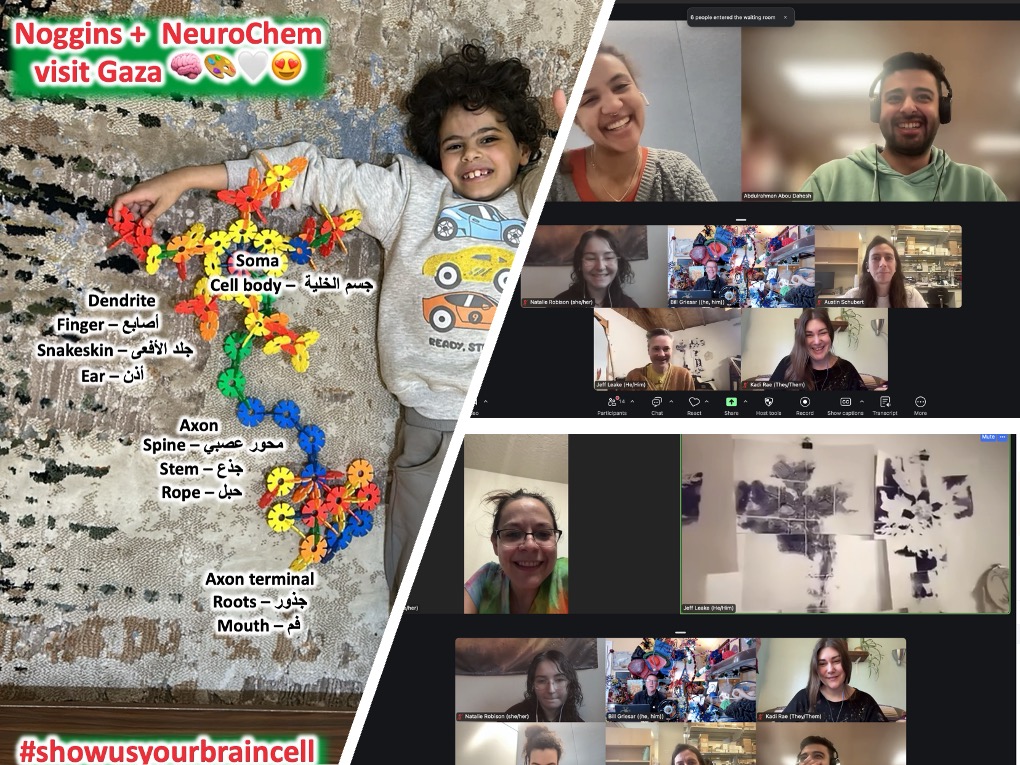
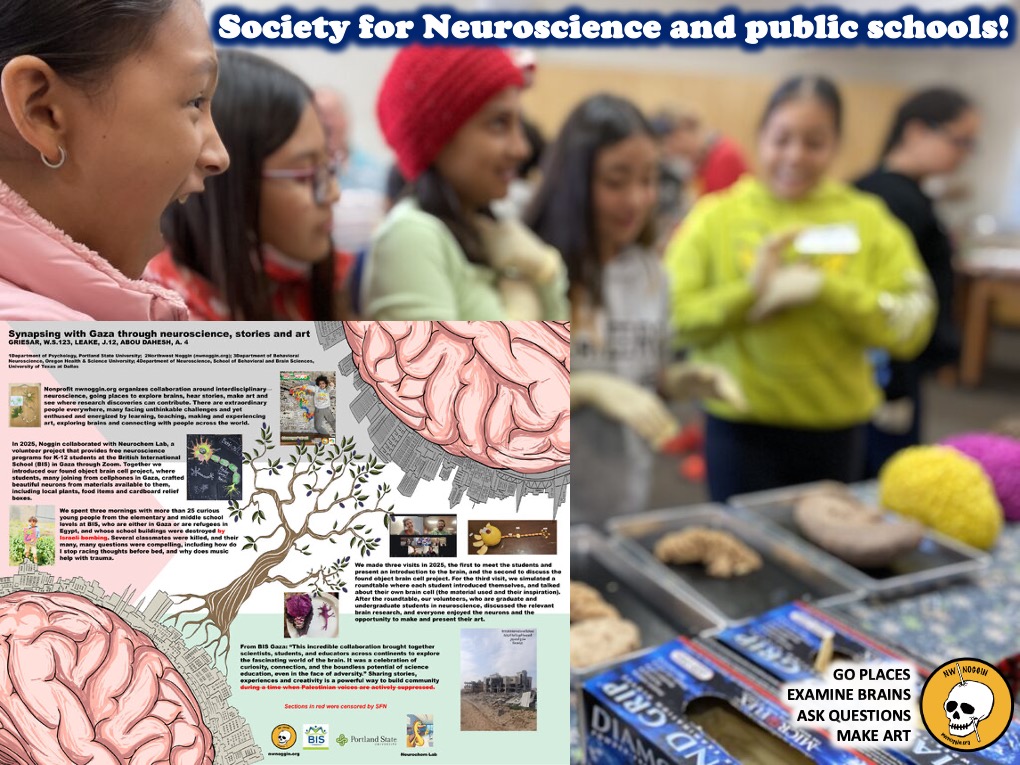
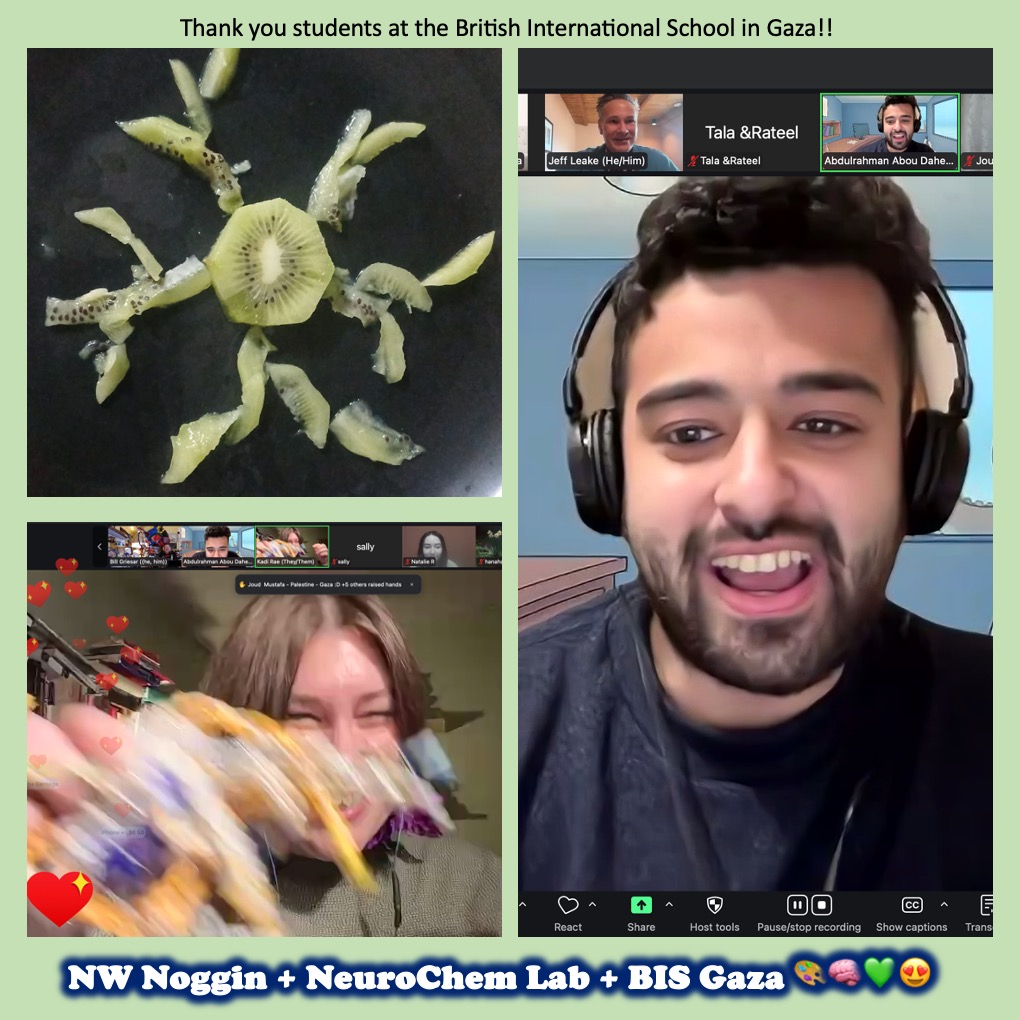
Together we met with young Palestinian students at the British International School in Gaza on three occasions through Zoom. We discussed their powerful questions, and shared related neuroscience research. The children were particularly interested in quieting their racing thoughts before bed, and were curious to learn about the brain and experiences of panic, memory, sleep, development, autism, and the power of music and art to help heal from traumatic experiences.
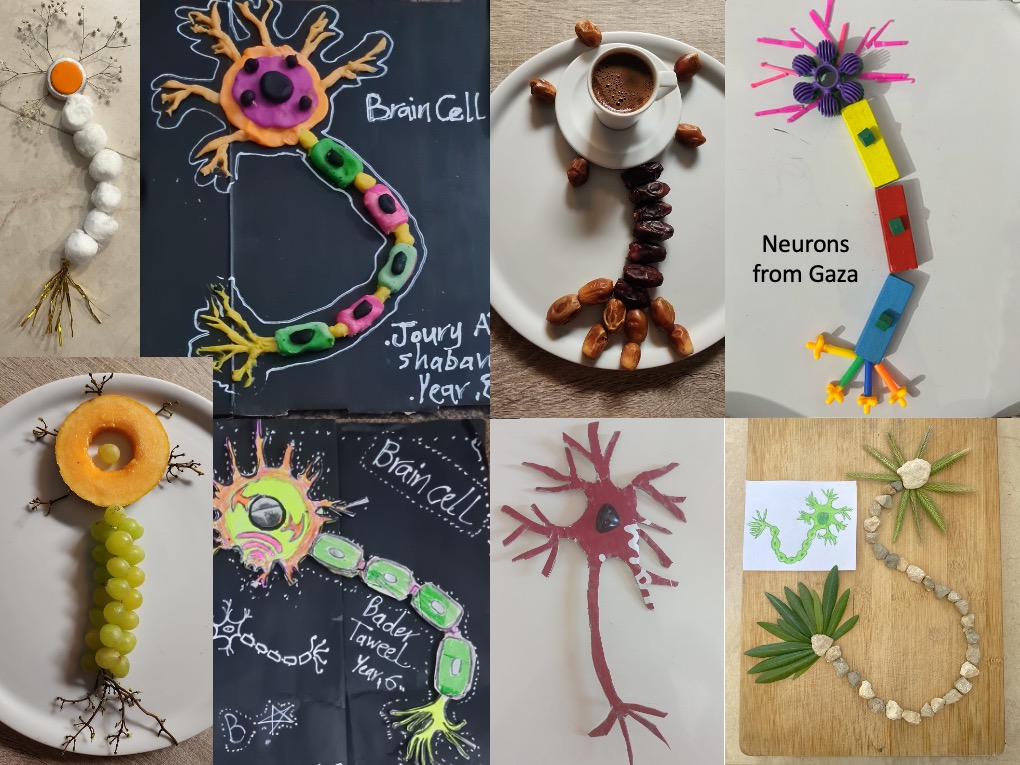
We explored research on the power of art and storytelling to process trauma, isolation and loss, and decided to create our own neurons out of objects available around us. We later shared those cells, and it was wonderful to see the creativity, excitement and joy in both students and volunteers.
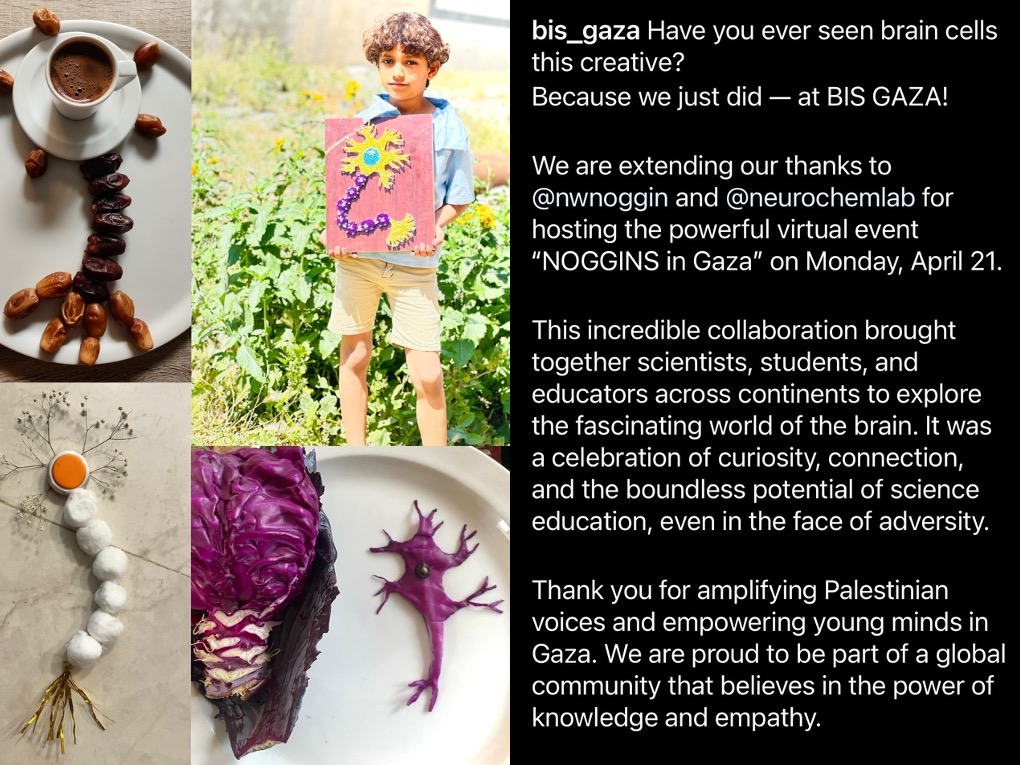
LEARN MORE: Found Object Brain Cells
LEARN MORE: Noggins in Gaza
Abstract SUBMITTED!
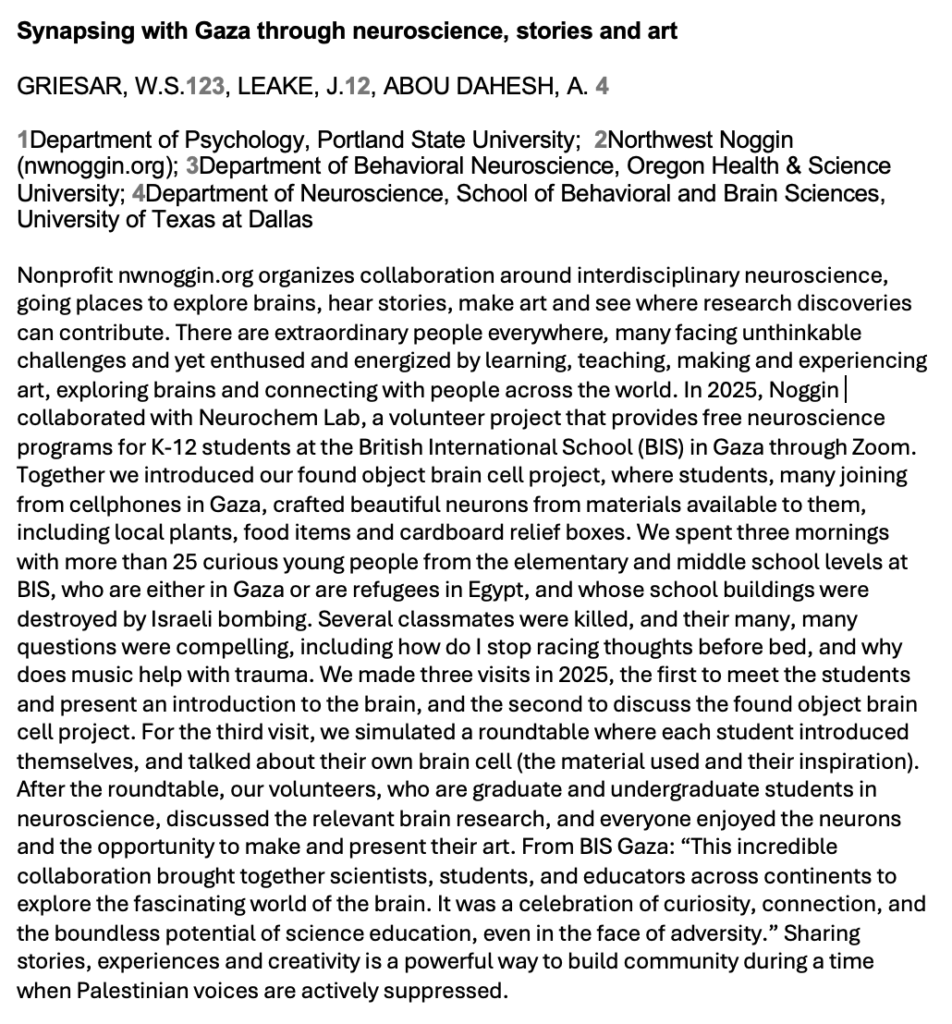
We submitted our 2025 SfN abstract on these timely and compelling outreach experiences in May…
Abstract DENIED!
And after a few months, we received this message from SfN…
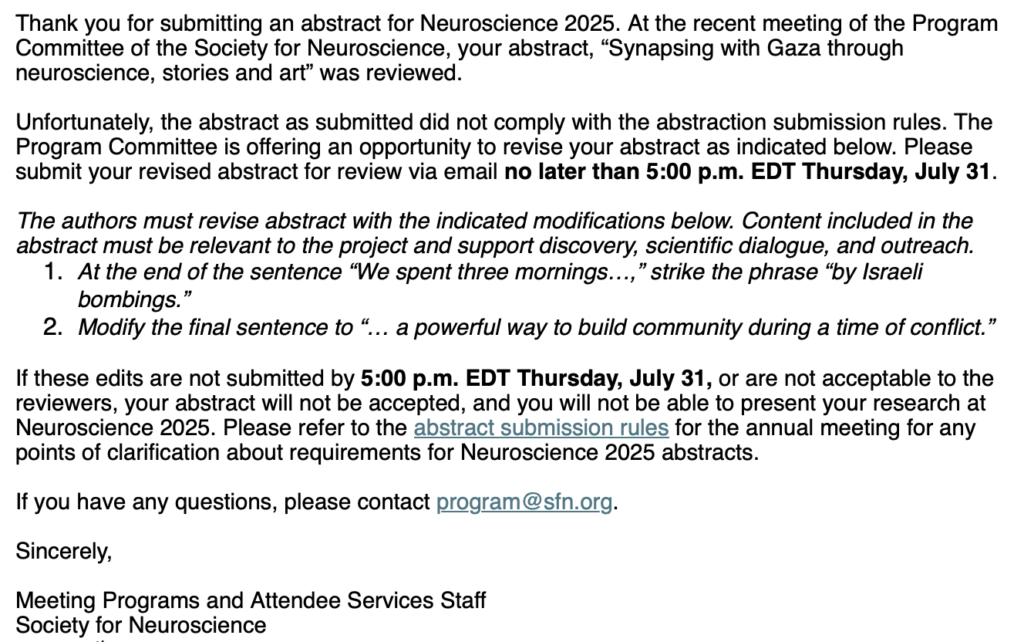
No names were attached to this request for revision (our Reviewer #2 moment, apparently).
How were these school buildings in Gaza destroyed?
Also, is their destruction not directly relevant to the trauma experienced by students, and the devastating loss of their friends, and the wrenching neuroscience questions they had about fight or flight, panic, and disrupted sleep?

And by censoring the last line: “Sharing stories, experiences and creativity is a powerful way to build community during a time when Palestinian voices are actively suppressed,” wasn’t SfN itself actively suppressing the voice of our Palestinian co-author?

The children’s school – along with so many others in Gaza – was destroyed, as declared in our abstract, by Israeli bombing. We could have accurately added the relevant fact that the bombs used to destroy their school were acquired with billions in funding from taxpayers in the United States.
LEARN MORE: Gaza: Israeli School Strikes Magnify Civilian Peril
LEARN MORE: Most of Gaza’s schools are destroyed and hundreds of thousands of children cannot go back to class
LEARN MORE: After Two Years of War: Gaza’s Education System on the Brink of Collapse
LEARN MORE: Gaza war: ‘Direct hits’ on more than 200 schools since Israeli bombing began
LEARN MORE: EDUCATION UNDER ATTACK IN GAZA, WITH NEARLY 90% OF SCHOOL BUILDINGS DAMAGED OR DESTROYED
LEARN MORE: Israeli attacks on Gaza schools could be crimes against humanity
LEARN MORE: UN condemns deadly West Bank airstrike, attacks on Gaza schools
LEARN MORE: U.S. Aid to Israel in Four Charts
One Noggin volunteer was so impacted by these visits that she wrote a deeply researched post about how current trauma-informed practices don’t always work in genuinely war-ravaged environments, and how she wanted to help improve them.

LEARN MORE: Safe Places in Unsafe Times
What we did next
We considered skipping the conference entirely, but first reached out to our wonderful SfN colleagues and friends. They were universally appalled at this response. After consultation with our Palestinian colleague, we decided to make the changes, and re-submit.
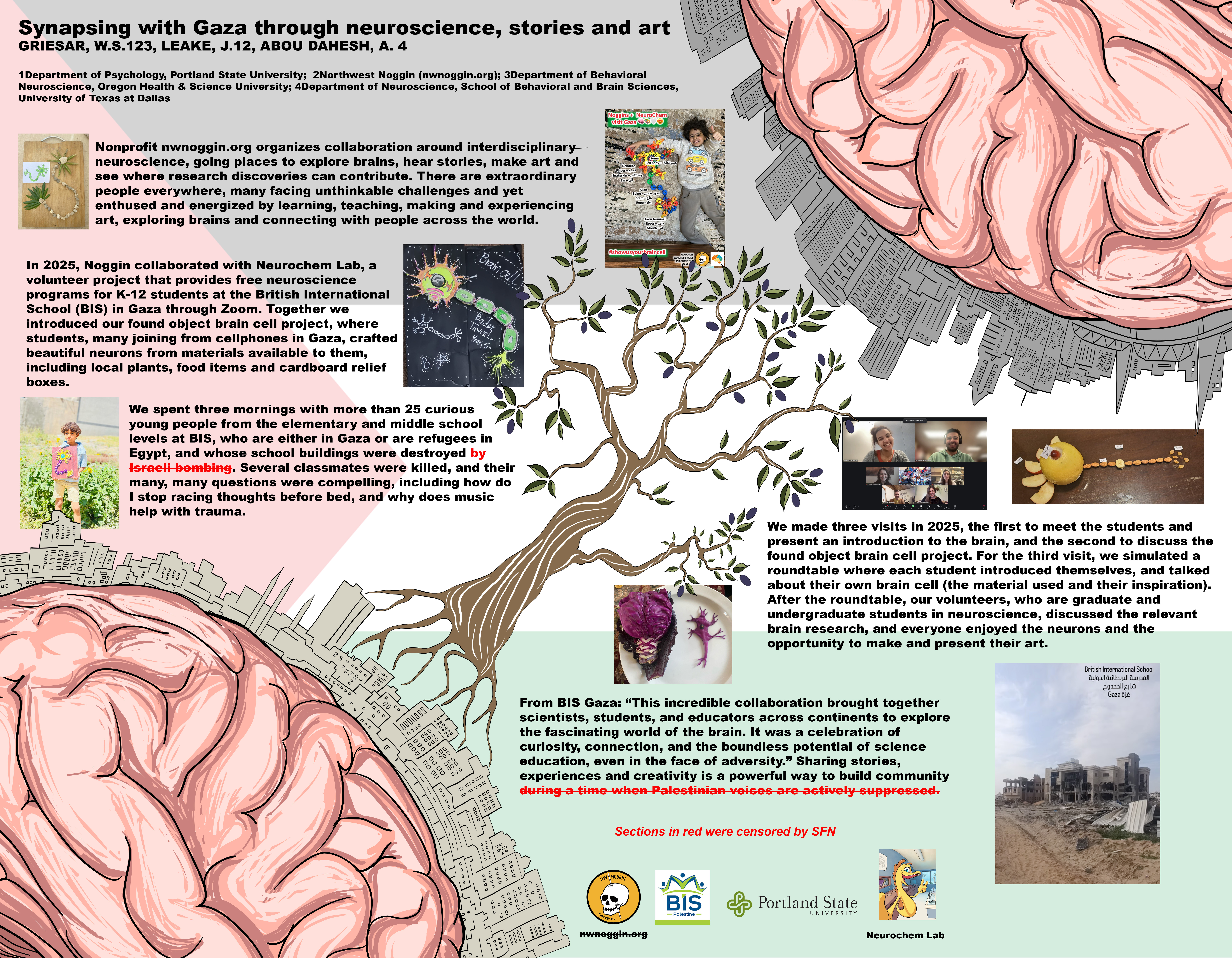
However the poster we brought to the conference contained our original abstract text, now highlighted in red, with a note acknowledging the censorship of relevant content imposed by the Meeting Programs and Attendee Services staff at the Society for Neuroscience.
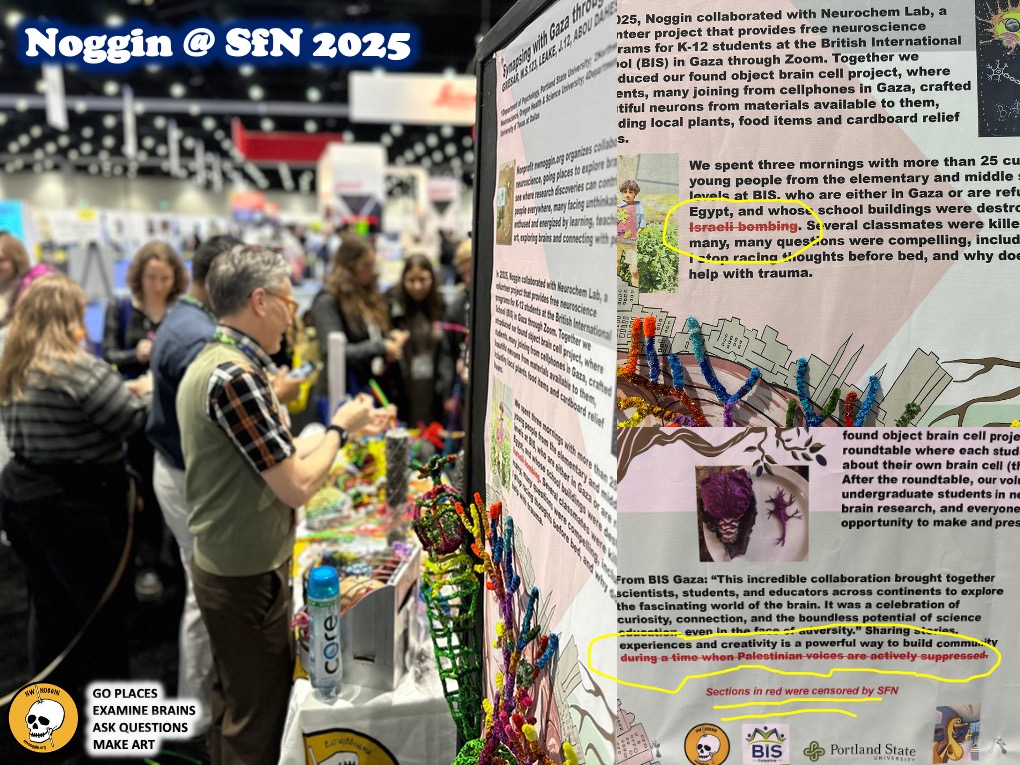
The response was phenomenal!
We met with so many amazing neuroscientists and neuroscience students during our two poster sessions in San Diego, who were thrilled to discover our collaboration with NeuroChem Lab and BIS Gaza. Many were also mortified (but often not surprised) to learn about SfN’s censorship.
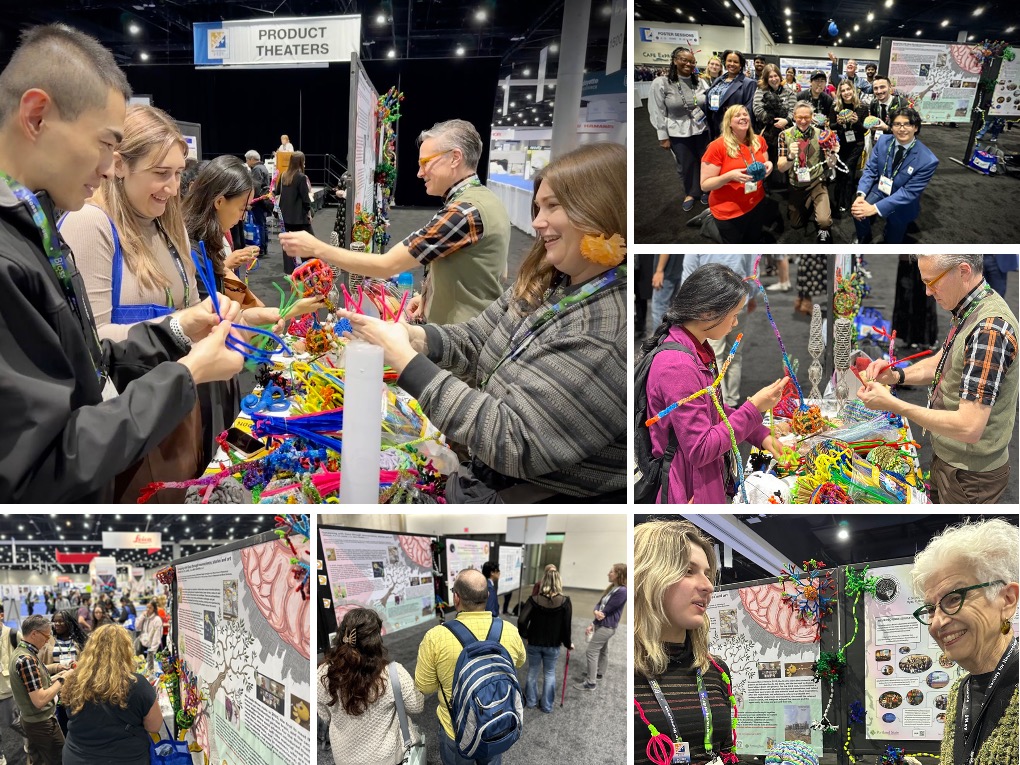
Several Palestinian-American researchers sought out our poster, including one who didn’t believe it existed! We were apparently the only abstract to mention Gaza at this conference of 20,000+ attendees. An SfN colleague told us that she’d searched abstracts for “Black” and “African” and, unlike the many submissions she’d found in past years, nothing came up for those terms either.
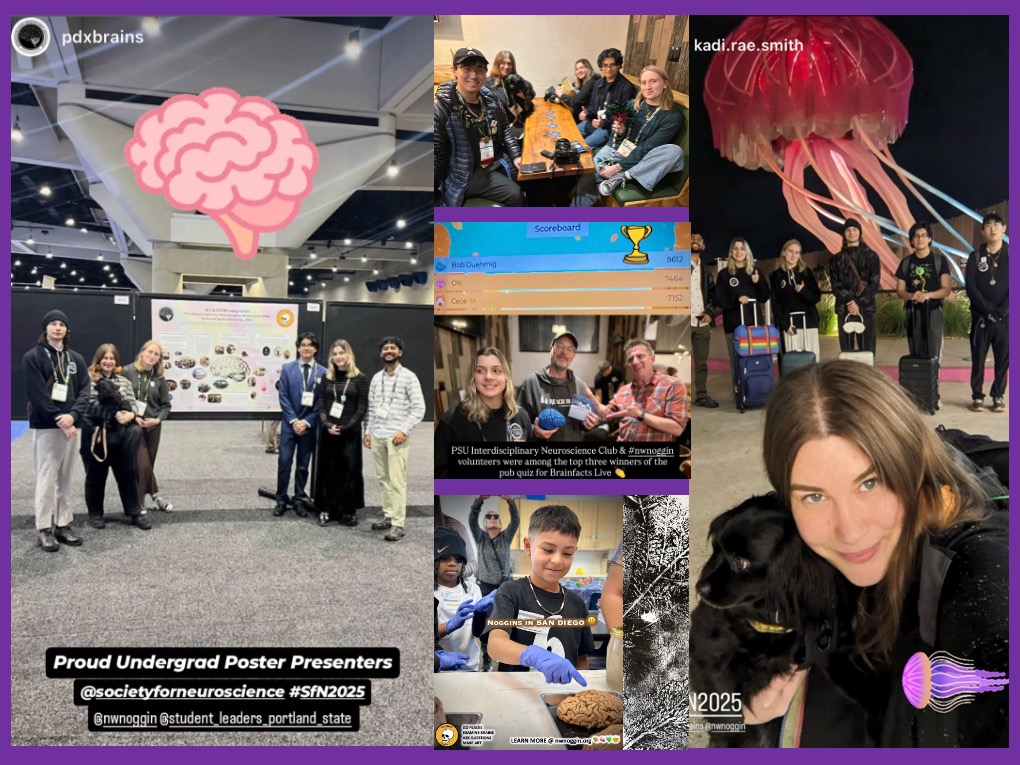
From Kadi Rae Smith, President of the Interdisciplinary Neuroscience Association @ PSU: “I had several people come up and say ‘Thank you for including this,’ and ‘This will be part of history, just wait a few years’ while I was working the posters on day two.”
“One Palestinian woman who is about to start grad school said she’s hoping to start working with kids in Gaza as soon as possible so that what’s happening to them won’t be lost to history. She said she wants to recall the poster so that people know what science is up against in times like these.”
Buildings mysteriously collapse
Meeting Programs and Attendee Services at SfN are not alone in attempting to diminish the experiences of Palestinians and their voices. The current U.S. federal government prevented our colleague and abstract co-author Abdulrahman Abou Dahesh from attending SfN, by announcing a blanket ban on U.S. entry for anyone with a Palestinian passport.
LEARN MORE: U.S. Suspends Visas for Palestinian Passport Holders, Officials Say
The title of our post is based on a passage from an incredibly powerful and relevant book by Canadian journalist Omar El Akkad: One Day, Everyone Will Have Always Been Against This.
It explains, perhaps, at least some of the failure of so many institutions, including media, tech platforms, universities (including our own), and professional associations like SfN to acknowledge the humanity of Palestinians, and the horror and depravity of the ongoing genocide in Gaza perpetrated by the government of Israel with support from the government of the U.S.
“To watch the descriptions of Palestinian suffering in much of mainstream Western media is to watch language employed for the exact opposite of language’s purpose – to watch the unmaking of meaning. When The Guardian runs a headline that reads, “Palestinian Journalist Hit in Head by Bullet During Raid on Terror Suspect’s Home,” it is not simply a case of hiding behind passive language so as to say as little as possible, and in so doing risk as little criticism as possible. Anyone who works with or has even the slightest respect for language will rage at or poke fun at these tortured, spineless headlines, but they serve a very real purpose.”
“It is a direct line of consequence from buildings that mysteriously collapse and lives that mysteriously end to the well-meaning liberal who, weaned on such framing, can shrug their shoulders and say, Yes, it’s all so very sad, but you know, it’s all so very complicated.…”
-Omar El Akkad, from One Day, Everyone Will Have Always Been Against This
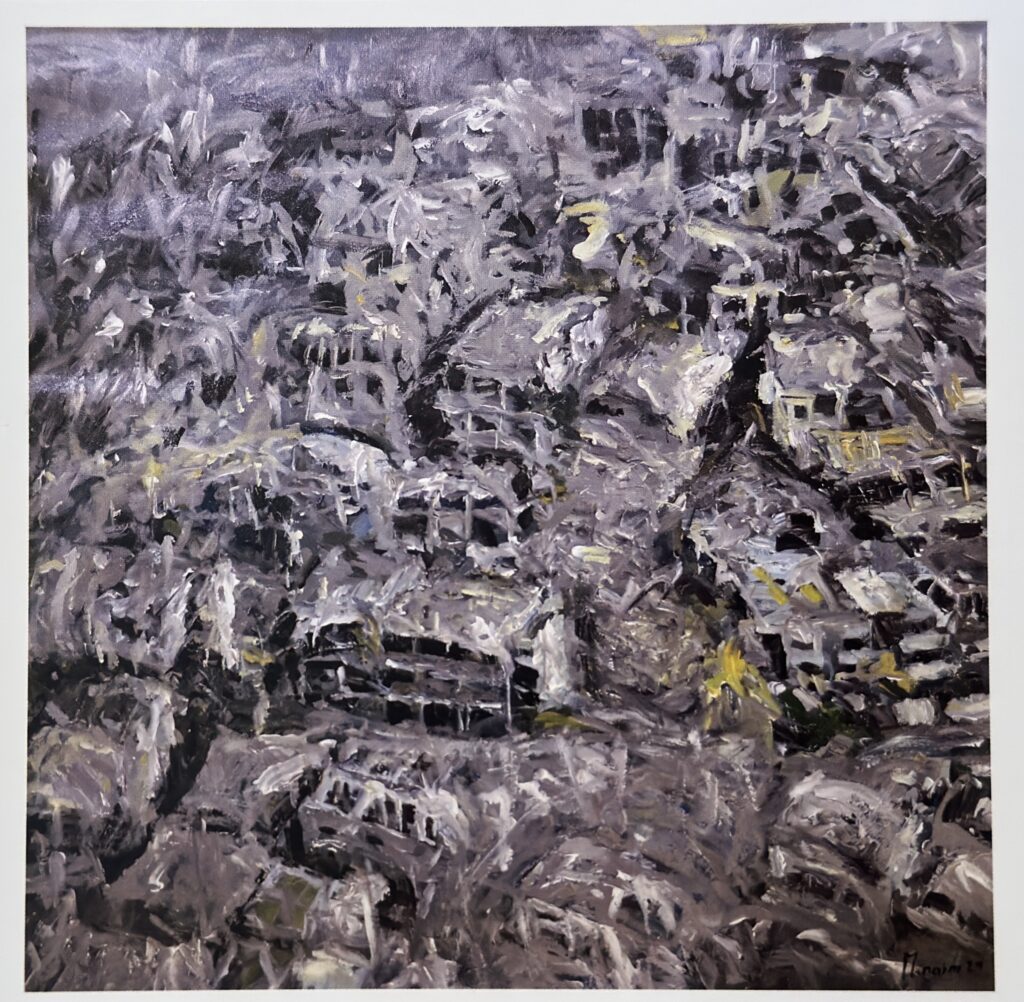
Destruction – Gaza, by Motaz Naim, at the Gaza Biennale 2025
LEARN MORE: Israel has committed genocide in Gaza, UN commission of inquiry says
LEARN MORE: Israeli necropolitics and the pursuit of health justice in Palestine
LEARN MORE: Civilian mortality and damage to medical facilities in Gaza
BEST PODCAST EVER ON GENOCIDE: Genocidology (CRIMES OF ATROCITY) with Dr. Dirk Moses
BEST PODCAST EVER ON GENOCIDE: Genocidology (CRIMES OF ATROCITY) Part 2 with Dr. Dirk Moses
What next?
So we love SfN! We had a blast presenting, mentoring undergraduates, sharing our experiences, discovering new research findings, and of course leaving the cavernous convention center to hear questions from students in San Diego Unified Public Schools!
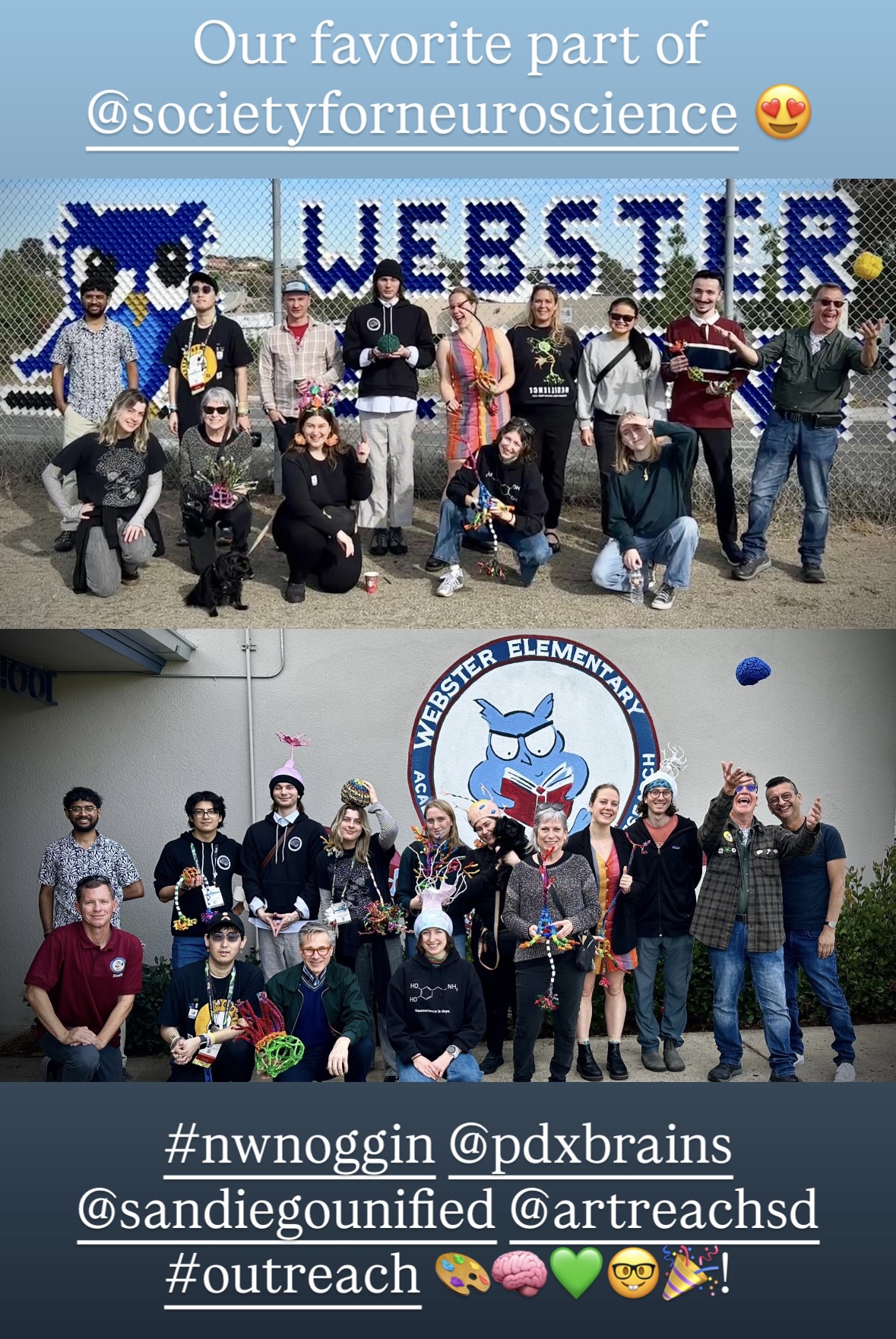
We’re also continuing to meet, along with NeuroChem Lab, with the students at the British International School in Gaza, and just finished making new found object GLIAL CELLS!
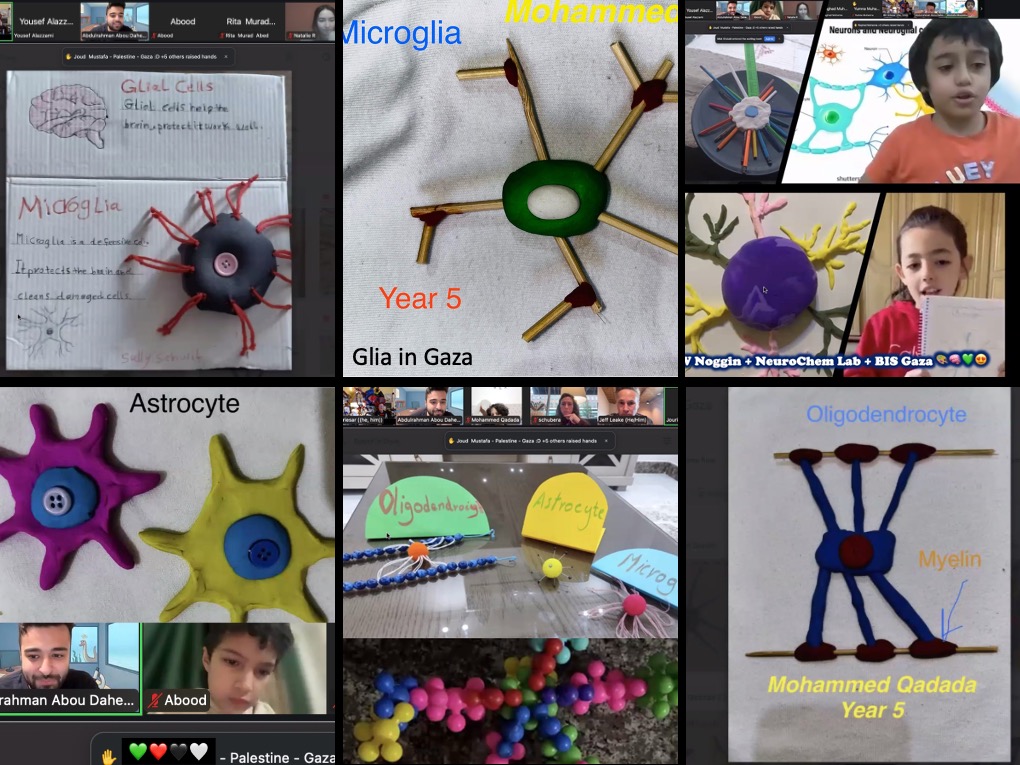
LEARN MORE: What about the glia?
LEARN MORE: Glia in Gaza
Next year the conference is in Washington DC, and we have questions.
How free are participants to present on their community outreach? We share neuroscience with many people who are NOT currently overrepresented in scientific research. Are there certain groups of people, certain nationalities or gender identities, for example, that are going to get censored at SfN?
Who will be able to attend a U.S.-based conference, given entry restrictions, outright hostility, and assaults, kidnappings and harassment by our current Department of Homeland Security and Immigration and Customs Enforcement (ICE)? Is it worth attending an international neuroscience conference when international participants can’t or won’t be there?
One thing we’ve learned from fourteen years of all-volunteer engagement, from urban to rural schools across the country and around the world, is that there are MANY options for sharing the joy and potential of arts-integrated neuroscience outreach. Lots of people care about brains, and the promise of research and art to address the curiosity, humanity and mental health concerns of everyone. Palestinians too.
So…we’re still looking! Advice appreciated. Stay tuned.