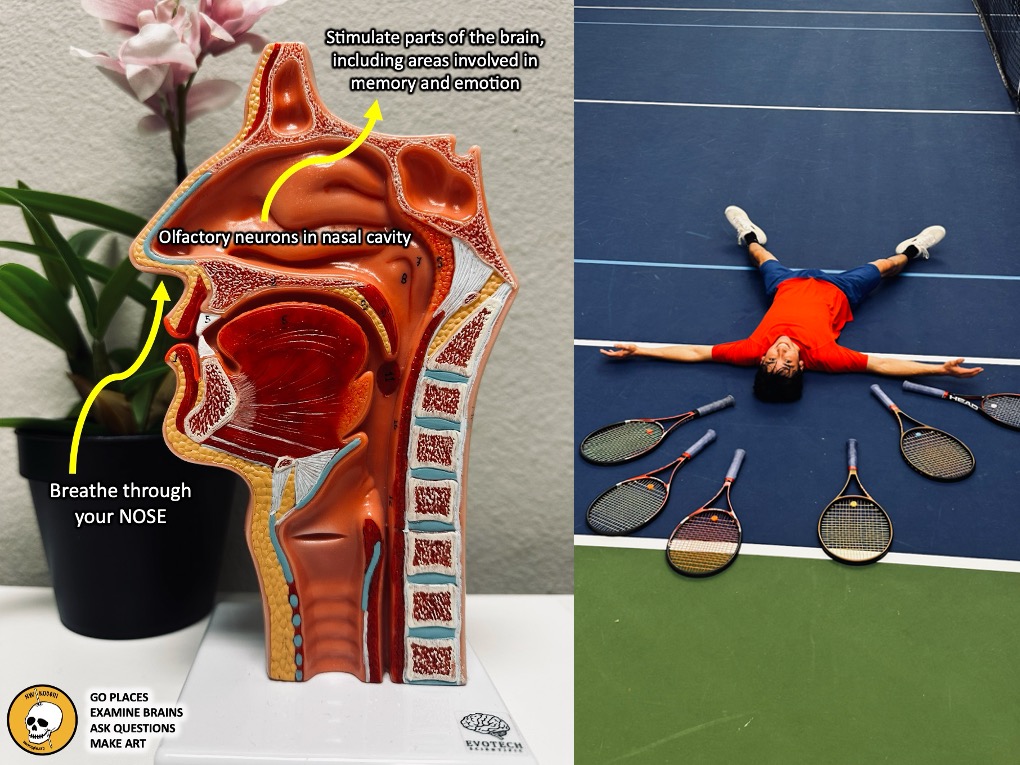
By Taiki Grover, an undergraduate in Speech & Hearing Sciences pursuing a minor in Interdisciplinary Neuroscience at Portland State University. Taiki is also a research intern at BreatheWorks, a speech and myofunctional therapy clinic in Lake Oswego, Oregon.

“Breath is the bridge which connects life to consciousness, which unites your body to your thoughts. Whenever your mind becomes scattered, use your breath as the means to take hold of your mind again.” – Thich Nhat Hanh
Before BreatheWorks…
I’m Taiki Grover, an undergraduate at Portland State University studying Speech & Hearing Sciences. Outside of school, I’m deeply invested in athletics — especially tennis, both as a player and a coach. I’ve always been curious about how to use my body to its full potential: how to move efficiently, stay focused under pressure, and recover well.

LEARN MORE: Grunting’s competitive advantage: Considerations of force and distraction
LEARN MORE: Long-term Tennis Participation and Health Outcomes
LEARN MORE: The Musculoskeletal Health Benefits of Tennis
LEARN MORE: Tennis Balls & Brains
That curiosity is what first led me to breathing (well – to an interest in breathing!). But later, I realized something much more important: breathing isn’t just an athletic tool. It’s a life tool.
Breathing shapes how we sleep, how we handle stress, how we focus, how we communicate, and even how we feel moment to moment. The more I learned, the more I saw how breathing supports everything we do, whether we’re on a tennis court, in class, or just trying to get through the day.
As a research intern at BreatheWorks, a speech and myofunctional therapy clinic in Lake Oswego, I’ve spent the past several months observing therapy sessions, studying airway development, and learning how breathing patterns influence the brain and body across the lifespan. What began as a performance question turned into a deeper exploration of anatomy, neuroscience, and human potential.
This post shares what I discovered — how breathing shapes us, how early habits matter, why retraining the breath can change the way we feel, and how something so simple can be one of the most powerful tools we have to improve our lives.
LEARN MORE: Breatheworks Homepage
LEARN MORE: What is Myofunctional Therapy?
Understanding sleep-disordered breathing (SDB)
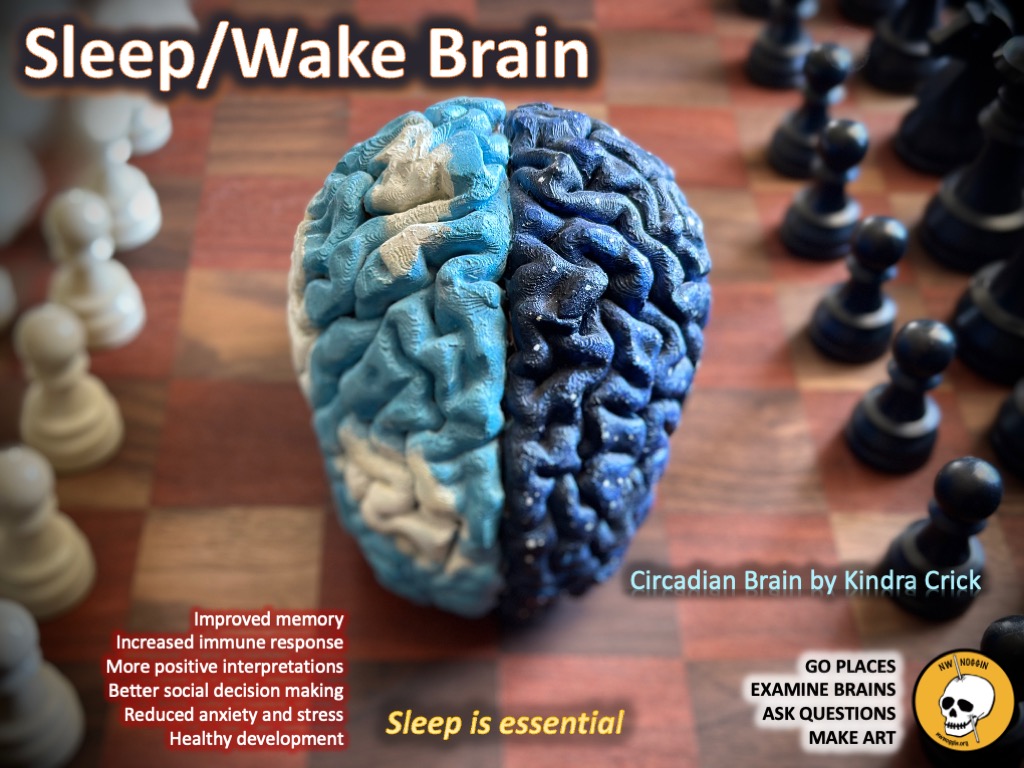
Before Breatheworks, I honestly never thought much about how I breathed when I slept. I just knew I woke up tired, with a dry mouth, and sometimes feeling like I hadn’t rested at all. I assumed that was normal. At BreatheWorks, I learned those are classic signs of sleep-disordered breathing, or SDB.
LEARN MORE: Sleep and breathing
LEARN MORE: BreatheWorks: Delving into Sleep-Disordered Breathing (SDB)
LEARN MORE: Mouth Opening/Breathing Is Common in Sleep Apnea and Linked to More Nocturnal Water Loss
SDB means your airway isn’t working the way it should at night. For some people, it looks like mouth breathing. For others, it’s snoring, tossing and turning, or those small “breath pauses” you don’t notice (but your brain definitely does!). On the more severe end is sleep apnea, where the airway actually collapses and the body has to jolt itself awake to breathe again.
What surprised me is how subtle unhealthy breathing can look.
Healthy sleep breathing is quiet, through the nose, with the tongue resting on the palate and the lips gently closed. Anything that pulls you away from that—mouth breathing, congestion, low tongue posture—can make sleep lighter and less restorative.
LEARN MORE: Do You Wake Up Tired?
LEARN MORE: What Is Sleep Apnea?
LEARN MORE: Sleep-Disordered Breathing
LEARN MORE: Delving Into Sleep-Disordered Breathing (SDB)
LEARN MORE: Mouth opening/breathing is common in sleep apnea and linked to more nocturnal water loss
LEARN MORE: Effects of mindful breathing combined with sleep-inducing exercises in patients with insomnia
How breathing shapes the brain
One of the biggest things I learned at BreatheWorks is that breathing affects the brain far more than I ever realized. I used to think that breathing was purely automatic — something happening in the background. But the route the air takes, nose versus mouth, actually changes how the brain processes emotion, memory, and focus.
Nasal inhalation sends rhythmic signals into the limbic system — especially the amygdala and hippocampus — the same areas that shape stress, mood, and memory.
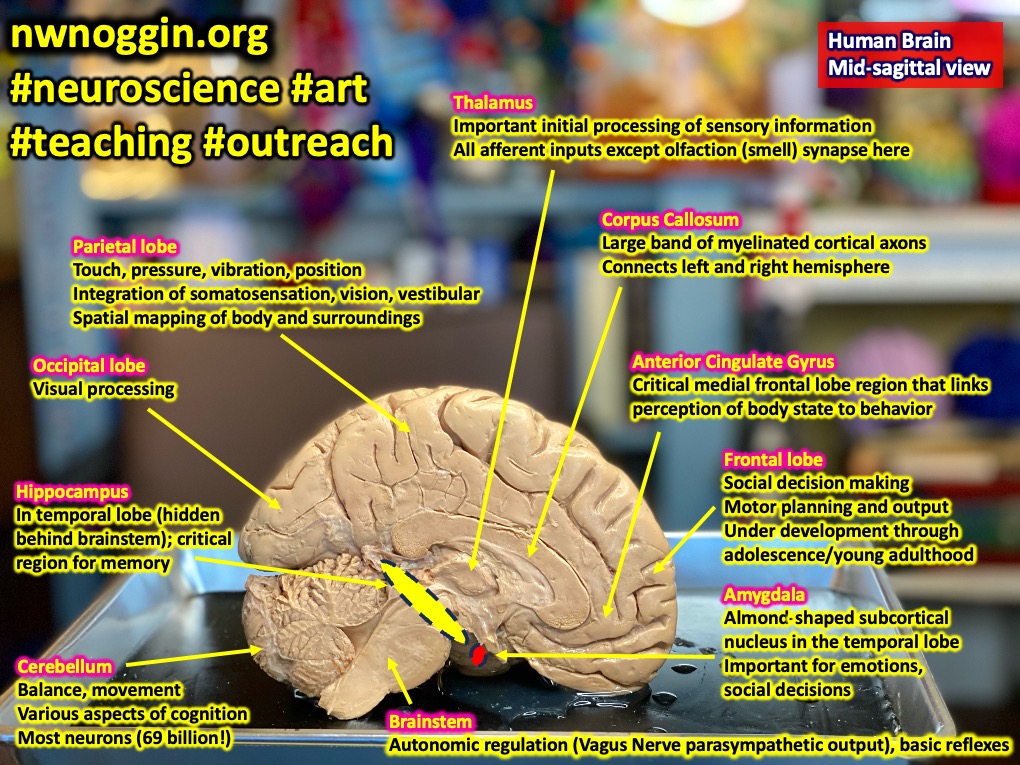
What surprised me most is that these emotional circuits also send signals back to the brainstem, adjusting how we breathe. So it’s not just “breathing influences emotion” — it works both ways.
LEARN MORE: Respiratory regulation & interactions with neuro-cognitive circuitry
LEARN MORE: Forebrain control of breathing: Anatomy and potential functions
LEARN MORE: Nasal inhalation synchronizes activity within the limbic system
LEARN MORE: Amygdala-Stimulation-InducedApnea Is Attention andNasal-Breathing Dependent
LEARN MORE: Decoding the neural circuits governing essential breathing behaviors
Nasal Airflow Activates Unique Brain Pathways
I also learned that nasal breathing isn’t just a different way of moving air — it activates sensory pathways that mouth breathing completely bypasses. When we breathe through the nose, airflow stimulates both the olfactory nerve and the trigeminal nerve. These signals go straight into brain regions involved in attention, emotional processing, and threat detection.
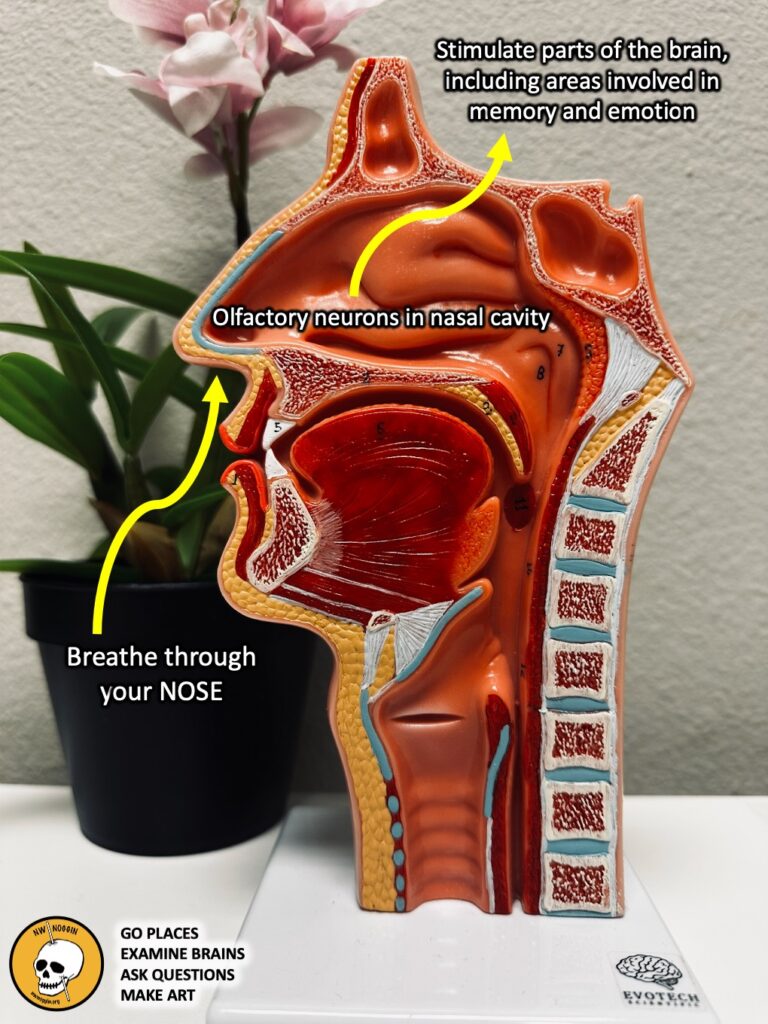
Once I learned that, nasal breathing stopped feeling like a “technique” and started feeling like something the brain actually expects and benefits from.
LEARN MORE: Olfactory–trigeminal integration in the primary olfactory cortex
Breath as a Neural Rhythm
Breathing works like a timing signal for the brain. Every nasal inhale activates the olfactory system, and that signal travels into deeper brain regions involved in awareness and memory. Research shows that activity in the olfactory bulbs and hippocampus literally rise and fall in sync with our breath, as if the brain were following along with each cycle.
In animal studies, when nasal airflow is blocked, this rhythm vanishes — and it comes back the moment nasal breathing returns. That moment made it clear to me: breathing isn’t just about oxygen. It’s a neural rhythm that shapes how we feel and how we focus.
LEARN MORE: Olfactory bulb drives respiration-coupled beta oscillationsin the rat hippocampus
LEARN MORE: Respiratory regulation & interactions with neuro-cognitive circuitry
Why This Matters
Taken together, these findings show that breathing isn’t just mechanical — it is neurological, emotional, and behavioral. Nasal breathing shapes how the brain fires, how we respond to stress, how we regulate emotions, and how alert or grounded we feel.
Learning to breathe through the nose doesn’t just change the airway — it changes the brain.
LEARN MORE: Amygdala-Stimulation-Induced Apnea Is Attention and Nasal-Breathing Dependent
LEARN MORE: Nasal Respiration Entrains Human Limbic Oscillations and Modulates Cognitive Function
LEARN MORE: Mouth breathing, “nasal disuse,” and pediatric sleep-disordered breathing
LEARN MORE: Global coordination of brain activity by the breathing cycle
What I Saw in Therapy
One thing I kept noticing at BreatheWorks is how early breathing habits stick with you.
A lot of kids had been mouth breathing for years, and even after their tongue-tie release or their congestion cleared, they still breathed the same way. The body doesn’t automatically switch back — it keeps the muscle pattern it learned.
What really stood out to me was how important tongue placement is. When the tongue sits low in the mouth, everything else falls apart: the lips stay open, the jaw drops, and kids end up working harder just to breathe or swallow. But when the tongue is in the right place, the whole system changes.
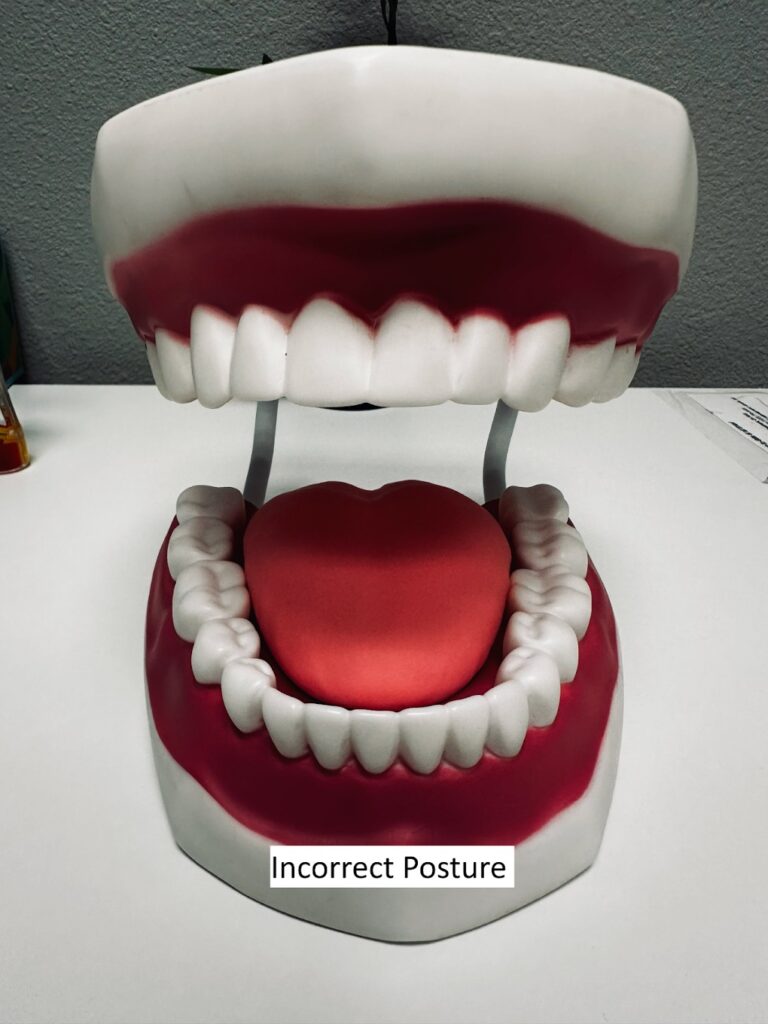
The “right place” for the tongue — something I repeated all day in therapy sessions — looks like this:
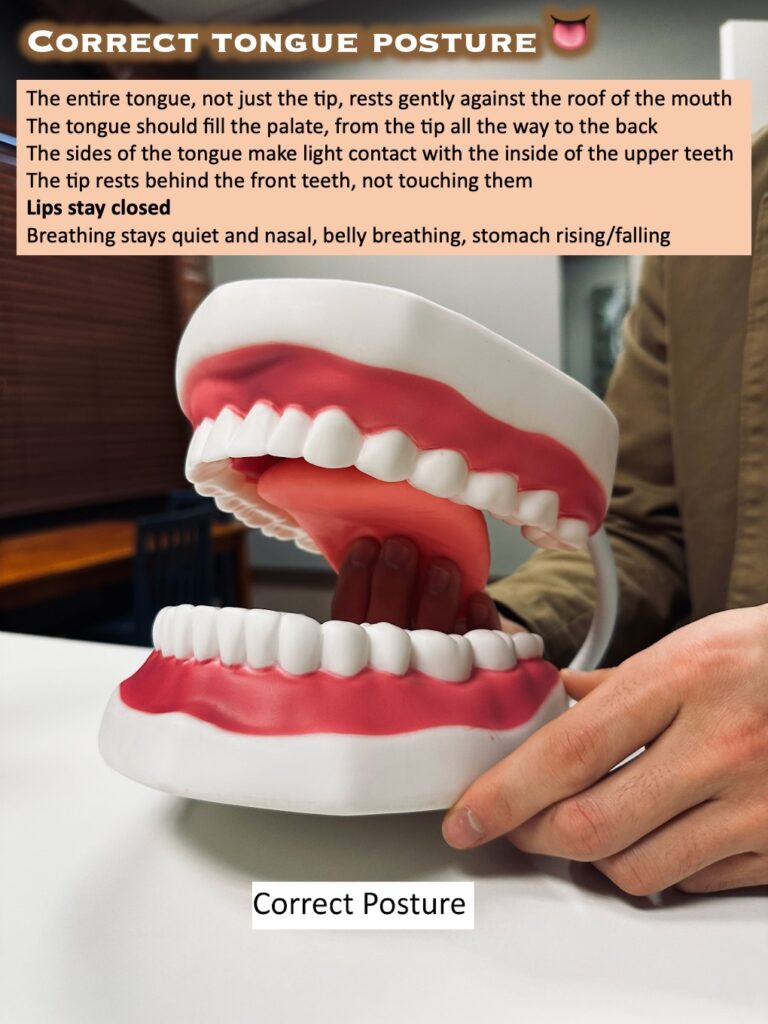
When kids finally found this posture, you could see the difference instantly — their airway was more supported, their swallowing got easier, and their whole face relaxed. I didn’t realize how big a deal tongue posture was until I watched how much effort kids used when their tongue wasn’t where it needed to be.
Seeing this made it clear why myofunctional therapy matters so much. Anatomy can open space, but habits decide how that space gets used. Without retraining, old patterns always come back.
LEARN MORE: Mouth Breathing, “Nasal Disuse,” and Pediatric Sleep-Disordered Breathing
LEARN MORE: The Effect of Mouth Breathing vs. Nasal Breathing on Dentofacial & Craniofacial Development
LEARN MORE: Tongue Posture, Tongue Movements, Swallowing & Brain Activation: An fMRI Study
LEARN MORE: Orofacial Myofunctional Therapy in Obstructive Sleep Apnea
LEARN MORE: Forebrain control of breathing: Anatomy and potential functions
Myofunctional Therapy Works
Myofunctional therapy (OMT) retrains the muscles of the face, tongue, and airway so people can breathe, swallow, and rest in a healthier pattern. In the clinic, I saw how small, consistent exercises—like lifting the tongue, sealing the lips, or practicing nasal breathing—gradually changed how patients used their muscles. People who had spent years mouth breathing or compensating for a restricted tongue suddenly had tools to move in a new way, and it showed up in how they slept, how they swallowed, and even how relaxed their faces looked.
One of the biggest things I learned is that OMT prevents relapse.
A lot of children get airway surgeries to create space — like adenotonsillectomy, which removes enlarged tonsils and adenoids, or palatal expansion, which widens a narrow upper jaw to make more room in the nasal cavity and tongue. Others get a tongue-tie release to free the tongue so it can lift to the palate or the roof of the mouth.
These procedures open the airway structurally, but they don’t change the breathing habits underneath. Without OMT, many kids go right back to mouth breathing because their muscles and patterns never actually changed.
That’s where OMT makes the biggest difference. It teaches the tongue where to rest, trains the lips to seal, and helps the airway stay supported. This is especially true after a tongue-tie release, which is a surgical release of the tissue under the tongue (the frenulum). I saw that patients who paired the procedure with OMT improved much more—they gained better tongue mobility, breathed more easily through the nose, reduced facial strain, and were far less likely to slip back into old habits.
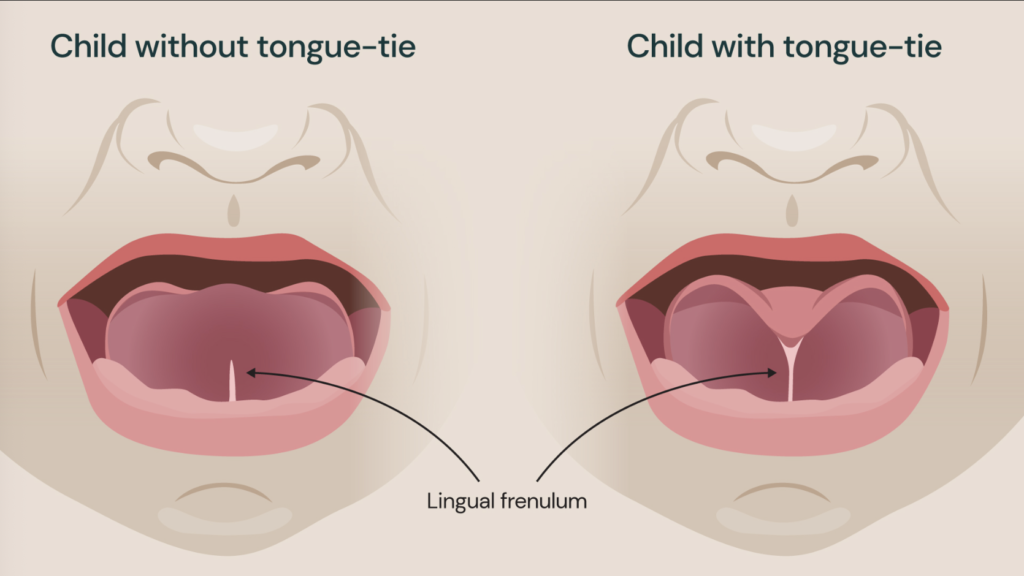
IMAGE SOURCE: Tongue-tie in children
It made sense once I watched it happen in real time: structure opens the airway, but function keeps it open. OMT is that functional aspect; it teaches the body how to use that new space.
Taken together, these findings show that breathing isn’t just mechanical — it shapes brain rhythms, emotional regulation, and body chemistry.
LEARN MORE: Mediating effects of sleep on mental health in older adolescents
Habit Formation: The Heart of Everything
Breathing isn’t only structural — it’s behavioral. One of the biggest lessons I learned is that mouth breathing becomes a habit, even after anatomy is corrected. Children and adults must retrain tongue posture, lip seal, nasal breathing, and swallowing patterns through repetition. These habits have to be practiced thousands of times until they become automatic. This is the true purpose of OMT.
LEARN MORE: Mouth breathing, “nasal disuse,” and pediatric sleep-disordered breathing
LEARN MORE: Orofacial Myofunctional Therapy in Obstructive Sleep Apnea Syndrome
LEARN MORE: Learning through mistakes!
LEARN MORE: A Dive Into Habits
Why it matters
Before this experience, breathing felt automatic — something that just “happened.”
“When the mind is fastened to the rhythm of breathing, it tends to become absorbed and calm. Whether on or off the court, I know of no better way to begin to deal with anxiety than to place the mind on one’s breathing process.” –W. Timothy Gallwey

Now I understand breathing as a complex neuromuscular behavior that shapes sleep, facial development, emotional regulation, cognitive clarity, posture, airway function, and overall well-being. Breathing may be invisible, but its effects are everywhere. Learning how it works — and how to restore it — has been one of the most meaningful discoveries of my general and athletic life.