


Post by Vivi Sierra, an undergraduate studying Psychology and minoring in Interdisciplinary Neuroscience at Portland State University. Vivi is curious to explore how environmental interactions affect how our bodies and brains perceive the world.

When I started visiting schools with Northwest Noggin I was nervous.
Speaking with people tends to be paralyzing for me, but I knew that trying to spark interest in STEM is crucial to the future. Along the way I made new friends and allies who were determined to share their own stories, and I had the pleasure of hearing so many different perspectives.
“How Many Brains Are There?”
During my outreach I listened to students and teachers ask different questions, and there were many to consider. However, one that really stuck out to me was “How many brains are there?”
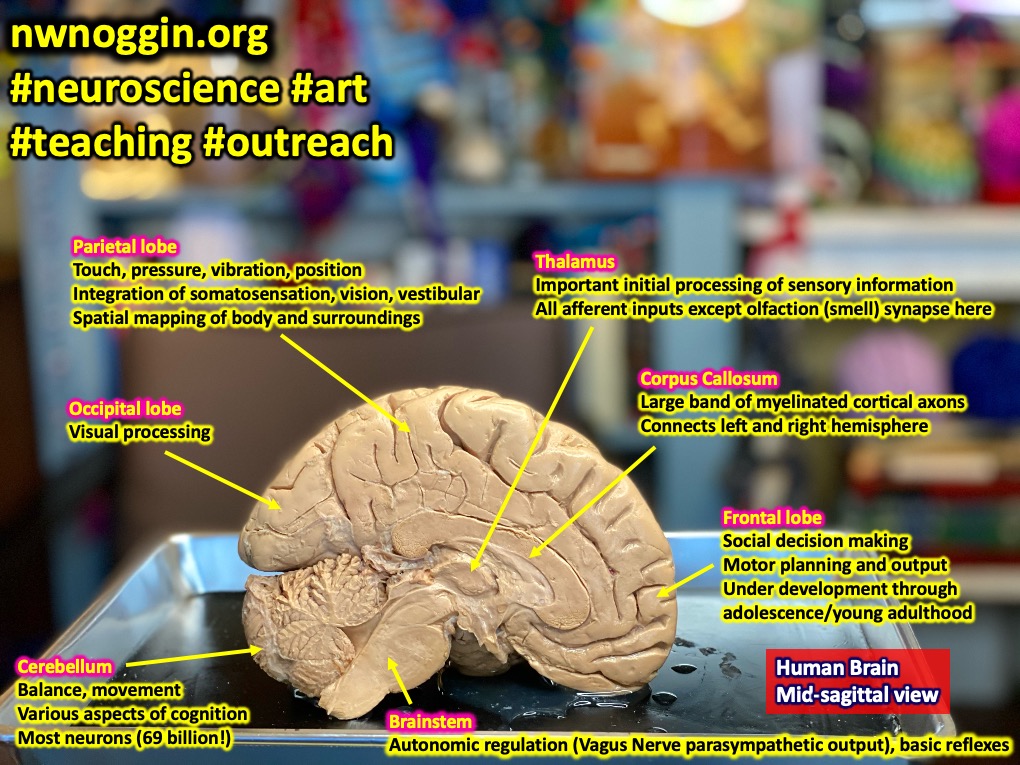
It seemed like a joke question, and it even got a few laughs from the room. However, the more I thought about it, the more I wondered about this same question myself.

“Which organisms have brains?”
On the surface it seems like you could just compare that question to “How many humans are there?”
And that question is pretty easy to answer. People tend to count other people. But it’s remarkable to consider all the human noggins that arrived on Earth in just the last fifty years, as the world’s population has DOUBLED in that short time, going from around 4 billion people to over 8 billion!
That means there are about 8.2 billion human brains here in 2025!
LEARN MORE: World Population by Year
LEARN MORE: Major Trends in Population Growth Around the World
More vertebrates!
But there are still more. For an accurate count, you have to add all the other vertebrates, because they also have brains. Vertebrates are creatures with vertebrae, the bones that surround the spinal cord, and also a cranium (skull) that holds their brain. Human are vertebrate animals, but there are so many more!

LEARN MORE: Long skinny lightning in Siletz
Vertebrates include most of our pets such as dogs, cats, birds, reptiles, fish, and many more.

LEARN MORE: Dogs Have the Most Neurons, Though Not the Largest Brain
LEARN MORE: Neural architecture of the vertebrate brain: implications for the interaction between emotion and cognition
LEARN MORE: Sorry, Grumpy Cat: Study finds dogs are brainier than cats
And then there’s all the wildlife!
With a little searching I was able to find an estimate of 5495 different species of endangered wildlife, so that was a start. There are (thankfully!) many sustained efforts to count endangered animals, because people are trying to keep them from dying out.
I also identified a world atlas which estimates that there are close to 8 million different animal species! Only 953,434 have been cataloged, which is a HUGE obstacle to making an accurate count of brains.

IMAGE SOURCE: Global warming and effects on the arctic fox
What I did learn is that rabbits alone count for about 709 million more brains, and fish a whopping 3.5 trillion! Birds add around 50 billion, and reptiles bring in another 92 million. The entire atlas is actually a blessing as it does a lot of the leg work for this question. But not ALL of the work!
LEARN MORE: Most Populous Animals On Earth
LEARN MORE: List of Endangered Species
LEARN MORE: Number of species threatened with extinction
LEARN MORE: How many species are there on Earth? Progress and problems
LEARN MORE: How Many Animals Are in the World in 2025
I thought about insects – do they have brains too?
All bugs have brains, however, this is where it gets interesting.
Insects do not have a big squishy cerebrum that has as much top down processing as our own human noggins. Instead, they have what is called a central complex, which is more like a brainstem. The central complex is found in all insect species and consists of a fan shaped body and an ellipsoid body, as well as a protocerebral bridge and two noduli. The larger concentration of cells is typically in the head portion of the insect, so I guess you can call that the “brain,” but their brain is, realistically, the entire system.
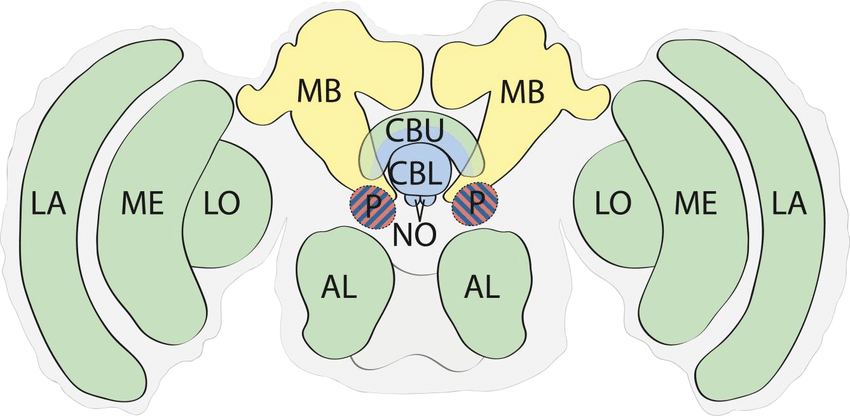
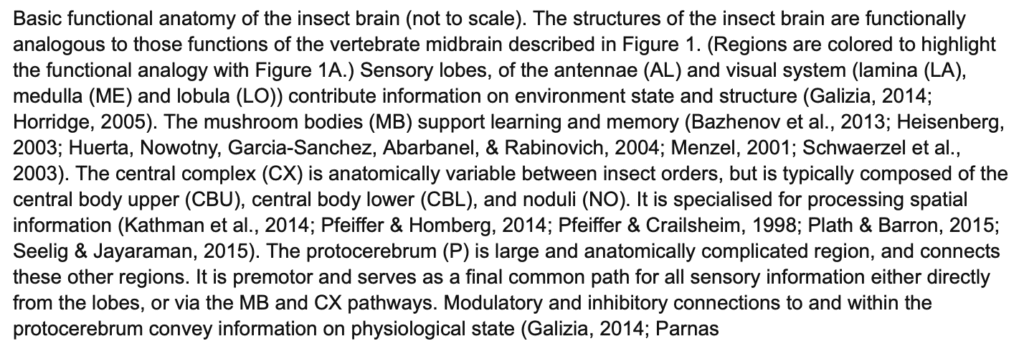
IMAGE SOURCE: Insects have the capacity for subjective experience
So insects definitely have brains, with areas analogous to parts of ours; for example there are regions devoted to processing visual input. If we consider insects to be in our “brain count” we then have to find out their approximate number. Apparently there are around 10 quintillion insects alive right now.
That’s 10,000,000,000,000,000,000!!
LEARN MORE: The connectome of an insect brain
LEARN MORE: Complete wiring map of the insect brain
LEARN MORE: Brain organization and the origin of insects
LEARN MORE: Numbers of Insects (Species and Individuals)
LEARN MORE: The insect central complex and the neural basis of navigational strategies
LEARN MORE: The Insect Central Complex—From Sensory Coding to Directing Movement
LEARN MORE: Organization and functional roles of the central complex in the insect brain
“Invertebrate animals with a segmented body, exoskeleton, and articulated appendages represent the largest phylum in the animal kingdom, Arthropoda, and account for over 80% of all known living species. They exhibit great biodiversity with a wide range of adaptations and forms such as insects, lobsters, crabs, spiders, scorpions, mites, centipedes, and millipedes that live in every habitat on earth.” -LEARN MORE: Arthropod Biodiversity: Ecological and Functional Aspects
Arachnids and crustaceans share a similar type of brain as insects.
Insects are arthropods, a phylum that also includes arachnids like spiders and scorpions, and crustaceans like lobsters and crabs. This decentralized brain structure allows for clusters of brain cells (ganglia) to be distributed across their bodies, which means that even if a ganglion near the head is damaged or removed the body can often keep on moving, if only for a little while!
LEARN MORE: Functional morphology and biomechanics of arthropods
LEARN MORE: Anatomy of the Nervous System in Chelifer cancroides (Arachnida: Pseudoscorpiones)
LEARN MORE: Cambrian origin of the arachnid brain
LEARN MORE: The “amphi”-brains of amphipods
The thought of creatures being so diverse is exciting to think about.

Then of course there are all the organisms WITHOUT vertebrae! Other interesting brains that we have to consider are those of ocean creatures that are not our regular, bony, fishy friends.
Invertebrates account for 95% of the population of the planet!
ALSO: some of these ocean invertebrates look like they came out of a science fiction book!
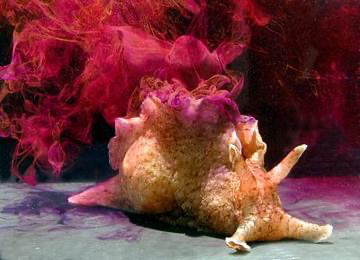
IMAGE SOURCE: Aplysia californica
For example, the Aplysia, or sea slug, has a network of intersecting nerves called a nerve plexus.
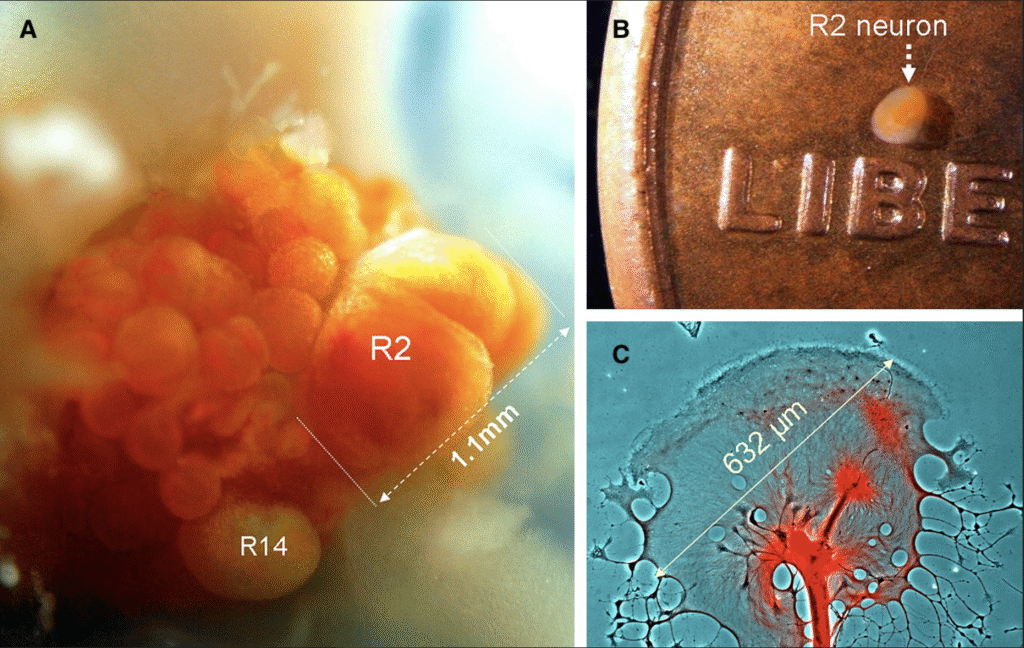
IMAGE SOURCE: Aplysia
Aplysia also have REALLY BIG NEURONS – up to 1mm wide in Aplysia californica.
You can see in relation to the penny above how massive an Aplysia neuron is. Because of its sizeable cells, Aplysia is often used in neuroscience research. A celebrated neuroscientist, Dr. Eric Kandel, won a Nobel Prize for discovering how memories form in both Aplysia and other animals, including us.
That’s exciting!
LEARN MORE: Eric Kandel Wins Nobel Prize in Medicine
LEARN MORE: Eric Kandel and Aplysia – Nobel Prize in Physiology or Medicine 2000
LEARN MORE: Discovering Memory: Using Sea Slugs to Teach Learning and Memory
LEARN MORE: Insight Into Human Behavior Through Animal Models
So, would creatures like that have a brain? How about the octopus, or the squid? Everyone has heard stories about how smart squid and other cephalapods are; they must have a brain.
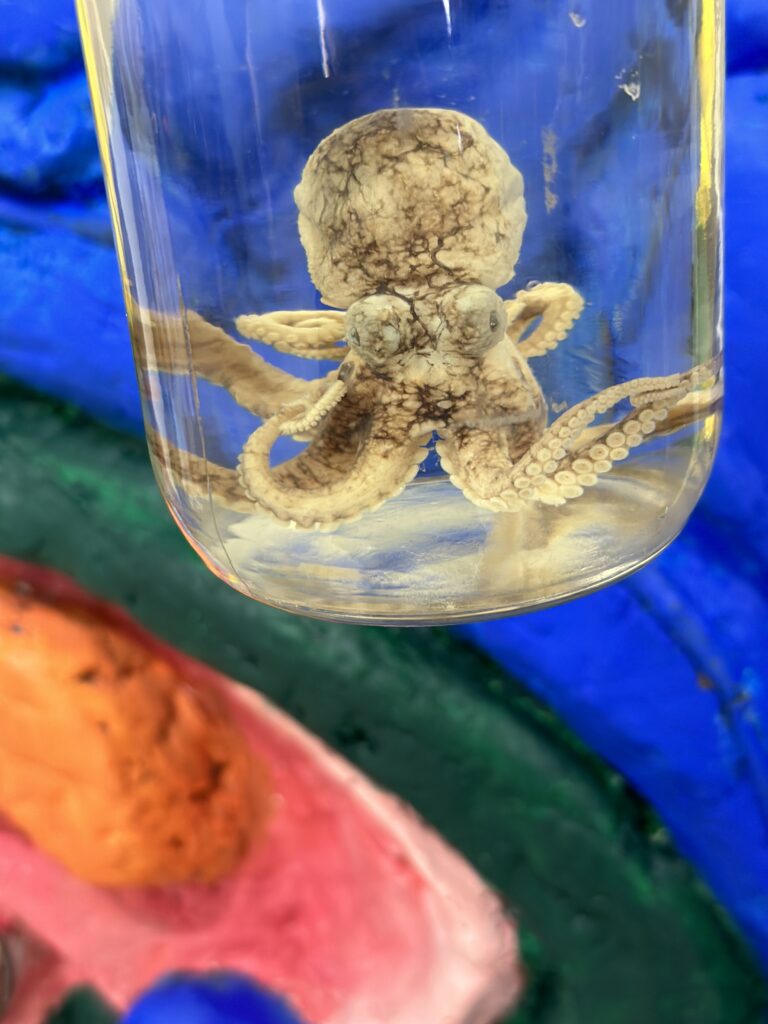
Cephalopods do in fact, have brains, but they are kind of spread out.
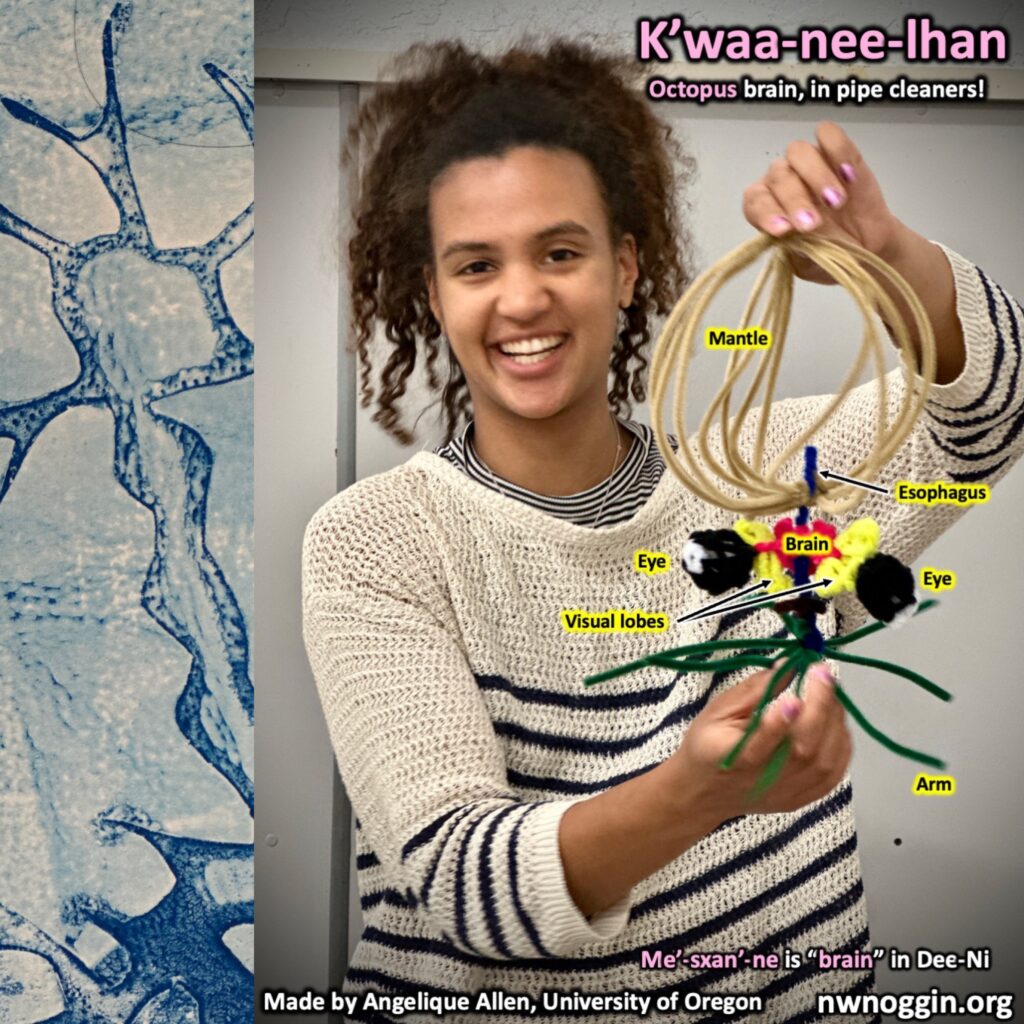
Their “brain” (or central ganglion) is wrapped around their esophagus (!!), along with two visual lobes. However, they also have eight significant ganglia, one in each arm, that independently control each arm’s movements and activities!
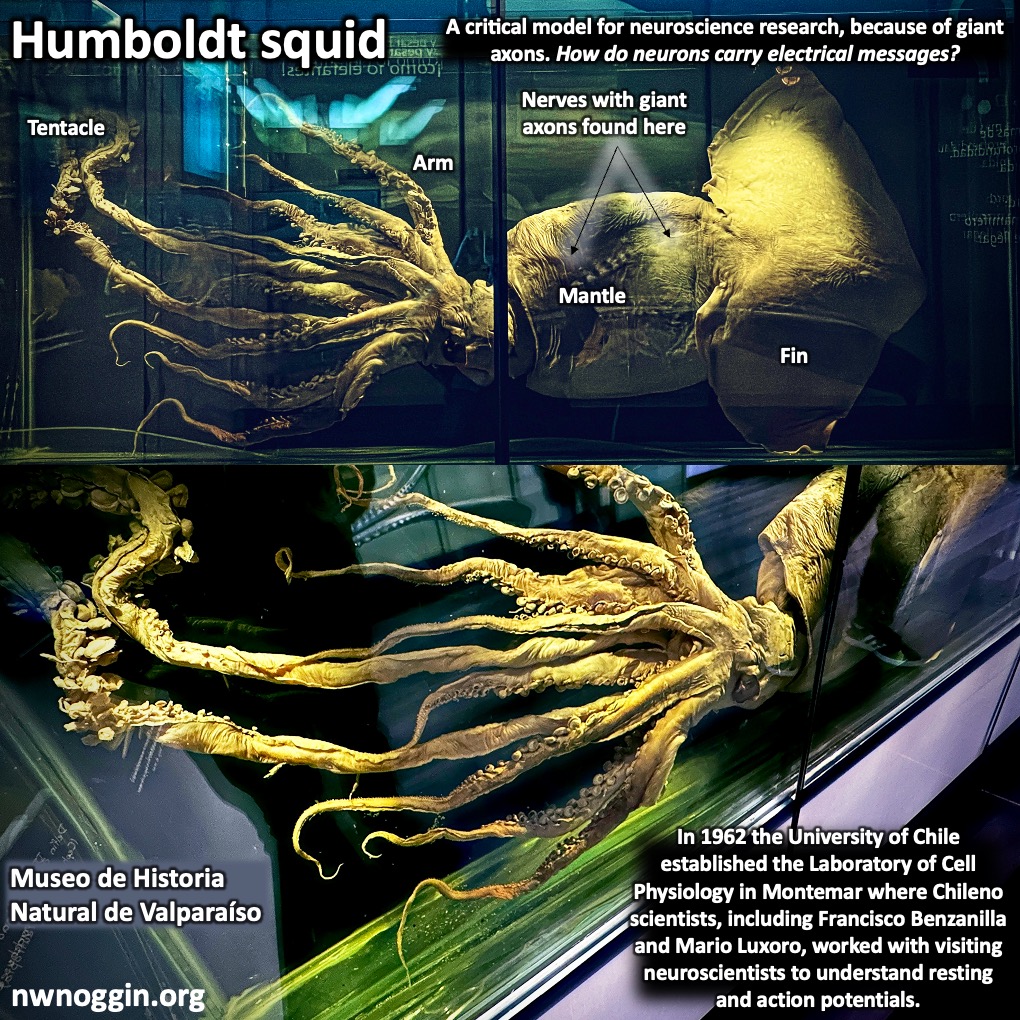
The squid also has played an important role in our understanding of how neurons carry electrical messages. Some squid, including the Humboldt squid found off the coast of Chile, have GIANT AXONS that made the implantation of recording electrodes possible for measuring electric currents. Our own wire-like axons carry electricity in the same way, to help us move, perceive and think.
LEARN MORE: Evolution of cephalopod nervous systems
LEARN MORE: Cephalopod Brains: An Overview of Current Knowledge to Facilitate Comparison With Vertebrates
LEARN MORE: Neurons and Glia Cells in Marine Invertebrates: An Update
LEARN MORE: Resting and Action Potentials of the Squid Giant Axon in Vivo
LEARN MORE: Memoria, Arte y Cerebros en Chile!
LEARN MORE: Squid Brains, Eyes, and Color
Our number of brains has gotten HUGE!
And I know there are more brains out there to find!
It’s important to keep ecosystems sustained so that we may discover new species. One way is through conservation efforts. The World Wildlife Fund and the Living Planet report document so much population decline because of human activity throughout the decades – as much as 73%!
LEARN MORE: Living Planet Report
It was really enjoyable to see conservation efforts involved in Portland Public Schools. When we visited Sunnyside Environmental School we were able to witness how student lesson plans included aspects of sustainability and ecological accountability.
LEARN MORE: Sunnyside Environmental School Mission
So what’s the number? How many brains???
While it may be impossible to determine the EXACT number of noggins on Earth, through some tedious calculations and intensive number crunching, I think I can account for AT LEAST 10,000,003,708,500,000,000 brains!!

OR IN OTHER WORDS: There are – right now – at least ten quintillion three trillion seven hundred eight billion five hundred million BRAINS ON PLANET EARTH!!
I may not have found an exact answer to how many brains there are, but I’m more inspired than ever to continue my search. I learned a LOT from student questions (thank you for your curiosity!!), and from Northwest Noggin, Dr. Bill Griesar, Professor Jeff Leake, and the rest of my outreach mates.

It was a blast and I look forward to volunteering again in the future!