


Post by Jalen Marcil, an undergraduate pursuing a Bachelor of Science in Public Health Studies: Pre-Clinical Health Sciences and a pre-professional track in Pre-Medicine, with minors in Aging Services and Interdisciplinary Neuroscience at Portland State University.

This spring I participated in outreach with Northwest Noggin, and visited different high schools and community events. I’ve had opportunities to describe how the brain works, share actual human and animal specimens, and answer many student questions!

This was a very eye-opening experience for me.
So often in our lives, I think we take unique learning opportunities for granted. Seeing kids light up and interested when they viewed a real brain made me realize that dissecting the cadaver in my Anatomy course, for example, is an experience that not everyone shares.

LEARN MORE: What is outreach like?
Do you ever have racing thoughts?
One question from a student at Portland’s Benson High School that stood out to me was, “Why does my mind not shut off at night?” I often ask this question myself, and at that moment in class, I didn’t have a good answer. So I decided to find out!

Racing thoughts are fast and repetitive, a driving stream of ideas, worries, and/or mental images that are often overwhelming and make it difficult to concentrate or relax. You can become fixated on what needs to be done, or the next steps you feel are required right now. You overthink!

Some people who suffer from racing thoughts also experience anxiety disorders, attention deficit hyperactivity disorder (ADHD), obsessive-compulsive disorder (OCD), bipolar disorder or depression. There is no exact figure that shows how many people are impacted. However, over 60 million people suffer from anxiety in the United States, and a significant number of them report racing thoughts.

Many people confuse racing thoughts and mind-wandering.
Mind-wandering is the mind’s tendency to move away from a task to something completely unrelated. Racing thoughts, in contrast, are associated with emotional lability (changeability, or the opposite of stability), which is more directly linked to several mental health conditions, including OCD.
As someone who has been diagnosed with OCD (obsessive compulsive disorder), I’m no stranger to racing thoughts, and they often come at the worst times. As a teen, I always wondered why it happened to me and believed there was just something wrong with my brain.

LEARN MORE: Prevalence of Any Anxiety Disorder Among Adults
LEARN MORE: Disentangling racing thoughts from mind wandering in adult attention deficit hyperactivity disorder
LEARN MORE: Where Is My Mind…? The Link between Mind Wandering and Prospective Memory
LEARN MORE: Racing and crowded thoughts in mood disorders: A data-oriented theoretical reappraisal
LEARN MORE: Obsessive-Compulsive Disorder: When Unwanted Thoughts or Repetitive Behaviors Take Over
LEARN MORE: Obsession and the Brain
LEARN MORE: What is OCD?
Where does it start?
A lot of overthinking involves the basal ganglia.
The basal ganglia are a set of interconnected gray matter structures located subcortically (below the cortex) deep in the cerebral hemispheres of the brain, extending from the base of the forebrain to the top of the midbrain. The basal ganglia contribute to our movement, motivation, and decision-making. They are also critical for when we start or stop movements and thoughts, and how fast these go.
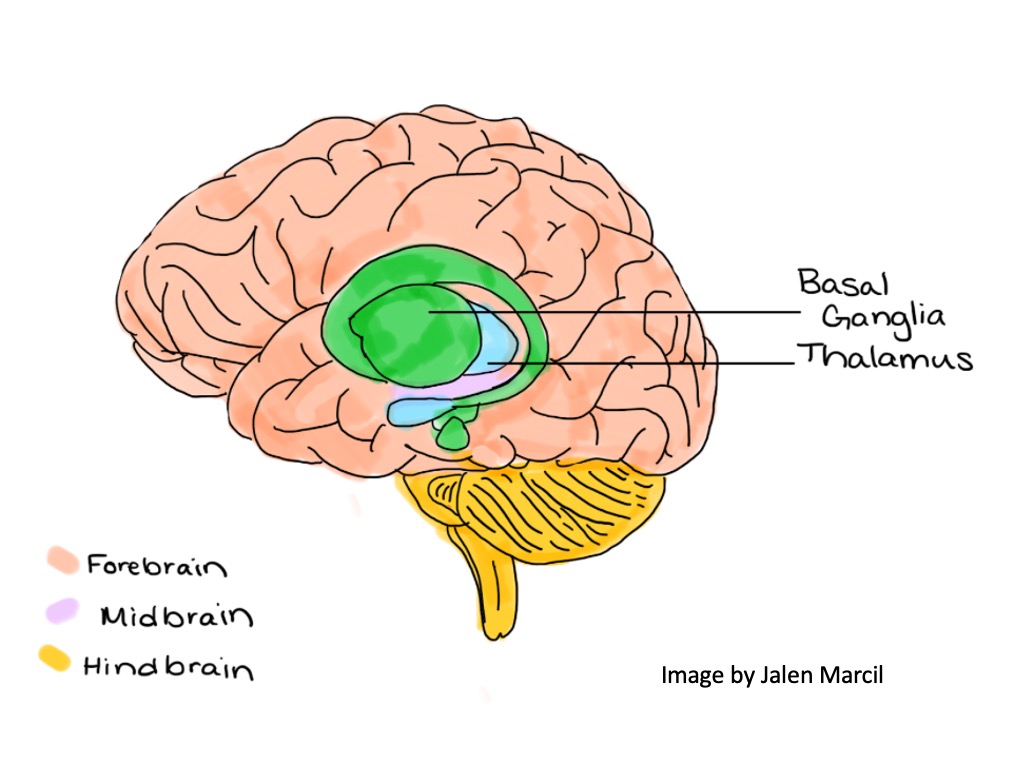
LEARN MORE: Neuroanatomy, Basal Ganglia
LEARN MORE: Functional Neuroanatomy of the Basal Ganglia
The basal ganglia are complex, but these three parts are very important: the caudate (Latin for “tail”) nucleus, the putamen (“husk”), and the globus pallidus (“pale globe”). Due to their striped appearance, they are collectively called the corpus striatum.
There are several names for basal ganglia structures, many derived from Latin. The putamen and the globus pallidus are collectively termed the lentiform nucleus, due to the shape they form, a lens-shaped body. The globus pallidus can be further divided into the globus pallidus internus and the globus pallidus externus.
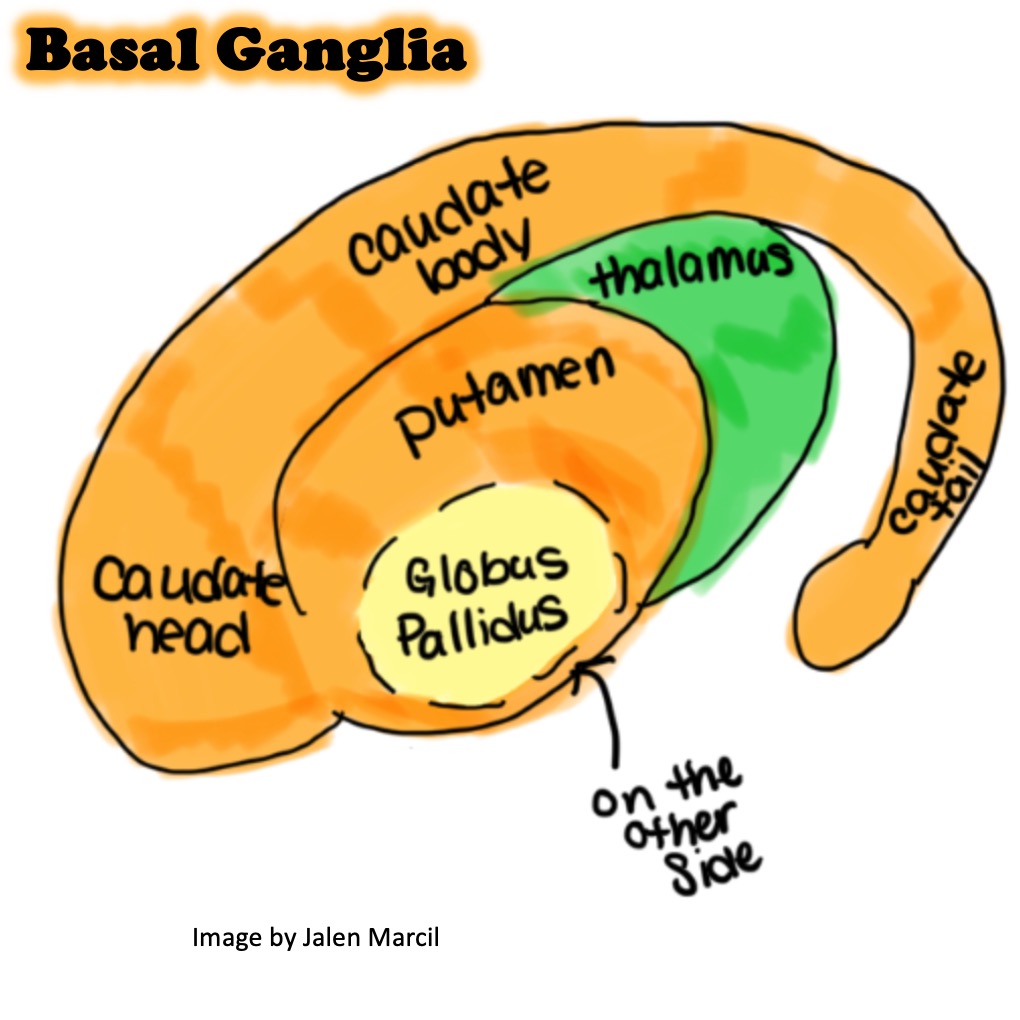
Additional basal ganglia structures include the substantia nigra and the subthalamic nucleus.
LEARN MORE: There’s a tail in your brain!
How does it work?
The basal ganglia work like a set of pathways, or circuits, that start, stop and time our actions.

Your brain is comprised of billions of neurons, which collectively control your body, thoughts, and movements. Circuits in the basal ganglia excite and inhibit, and determine the precise timing and rate of our activity, either promoting or suppressing movements and, remarkably, even our own thoughts.
The basal ganglia receive significant input from networks in our frontal lobes, where we plan activities, make predictions about potential actions and consequences, and consider our next social steps. When the basal ganglia aren’t functioning optimally, they can impair our consciousness, and this can lead to impulsive movements (tics, for example), along with unwanted, intrusive and racing thoughts.

The basal ganglia contribute to three pathways: the direct, indirect, and hyper-direct pathways.
All three pathways converge on the thalamus, where neuronal projections to motor cortex (including primary motor cortex, or M1, in the frontal lobes) can excite and allow for movement to proceed.
The DIRECT PATHWAY initiates and executes movement and thoughts.
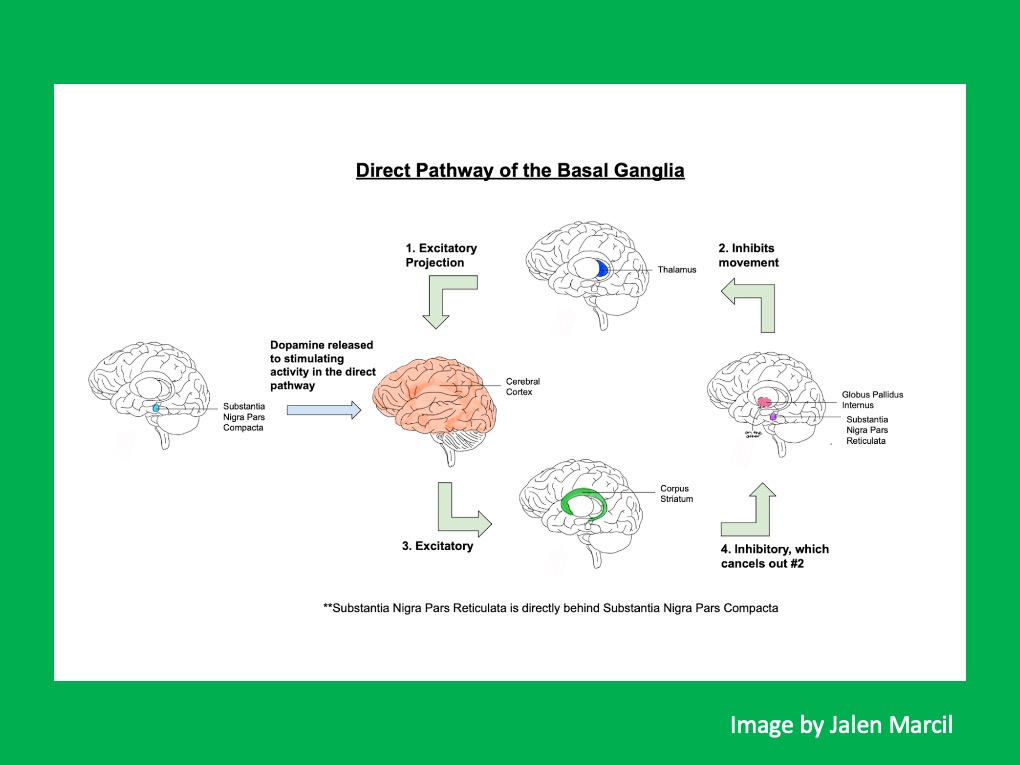
The direct pathway activates the thalamus. The corpus striatum, globus pallidus internal and substantia nigra pars reticulata act to turn off inhibition of the thalamus, which lets thalamus excite the cortex, resulting in movement – and thought!
The INDIRECT PATHWAY, in contrast, STOPS unwanted movements and thoughts.
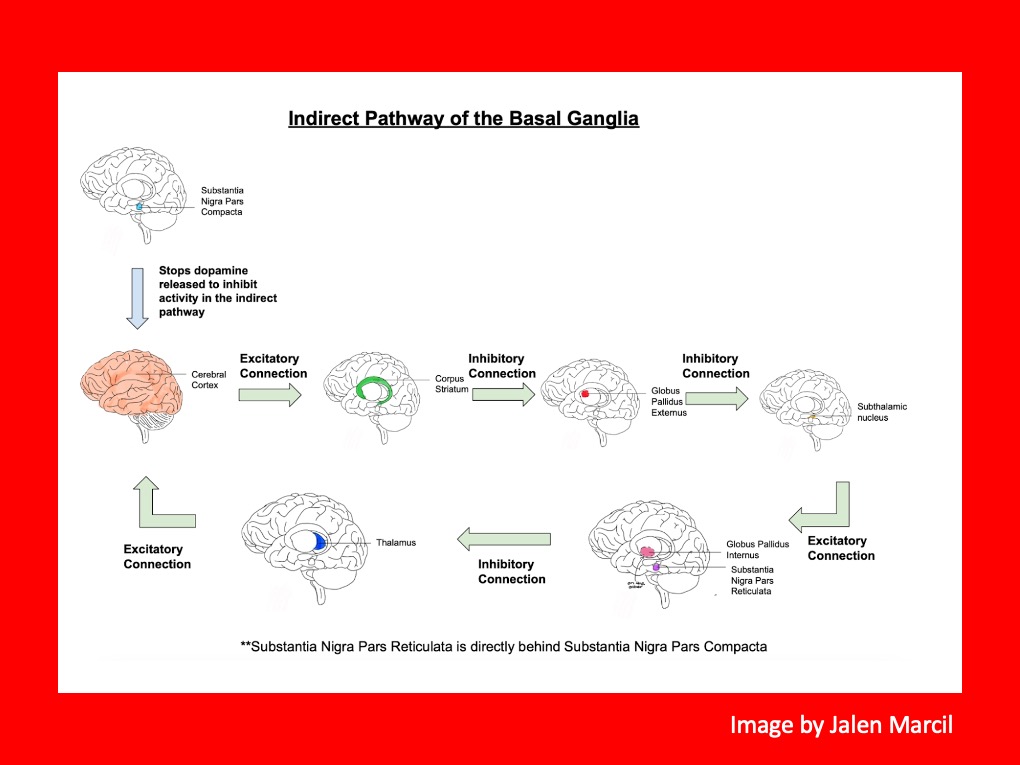
The indirect pathway generally leads to the inaction of the thalamus, and a reduction in action. However, there is a lot of active research on this topic, and the contributions of both direct and indirect pathways may be more complex depending on other aspects of your current situation.
The hyper-direct pathway is a quicker way to prevent movement.
It takes the same route as the indirect pathway but skips over the corpus striatum.
There is a complex balance between the direct pathway and the indirect pathway, and a balance between activation and inhibition. The direct pathway pushes the thought; for it to stop, the indirect pathway usually must engage. This balance allows you to maintain attention and helps prevent you from being overwhelmed by a constant stream of intrusive and irrelevant thoughts.

LEARN NORE: The Cortico-Basal Ganglia-Cerebellar Network: Past, Present and Future Perspectives
LEARN MORE: Multiple dynamic interactions from basal ganglia direct and indirect pathways mediate action selection
LEARN MORE: Cognitive-motor interactions of the basal ganglia in development
LEARN MORE: Basal ganglia circuit loops, dopamine and motivation: A review and enquiry
LEARN MORE: When Thoughts Are in a Race: Area 10 and Bipolar Disorders
LEARN MORE: Functional Neuroanatomy of the Basal Ganglia
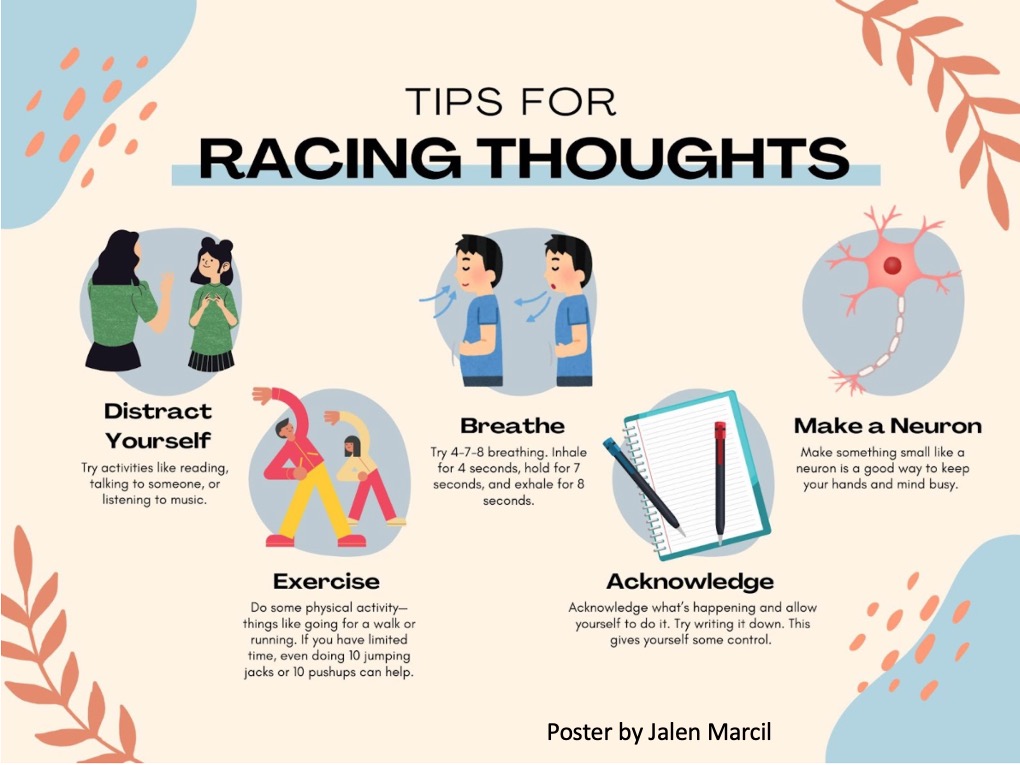
How to slow them down?
There is no one solution for racing thoughts, but there are several strategies that can help.

LEARN MORE: Slowing down racing thoughts
LEARN MORE: How To Stop Your Mind From Racing and Get To Sleep
LEARN MORE: ADHD Racing Thoughts: Understanding, Managing, and Overcoming Mental Hyperactivity
LEARN MORE: Attempts to control unwanted thoughts in the night
LEARN MORE: I can’t sleep, my mind is racing!
LEARN MORE: STEAM Art Projects
Outreach has been one of my favorite experiences at Portland State.

It let me see how my own knowledge and research skills, and my own experience, can be applied to questions in a community setting, and also gave me the chance to learn along with K-12 students and members of the public about neuroscience and our brains.